Innovation at Volkswagen

"Volkswagen Motorsport has broken new ground with the ID.R and demonstrated the enormous potential of the electric drive worldwide with its records. Now it has recently been announced that the time has come for the next step towards the future: "Volkswagen is also consistently committed to e-mobility in motorsport and is saying goodbye to the combustion engine at the factory," explained Dr. Frank Welsch, Member of the Board of Management of the Volkswagen Passenger Cars brand, Technical Development Division.
Sven Smeets, Director of Volkswagen Motorsport, explains: "Electromobility offers huge development potential and motorsport can provide important impetus as a pioneer: On the one hand, it serves as a rolling laboratory for the development of future production cars and, on the other, as a convincing communication channel to get people even more enthusiastic about electric mobility. That is why we will focus more than ever on the electric drive in the factory and further expand our activities with the development of the MEB. Our focus is on innovative technology that is relevant for the car of the future."
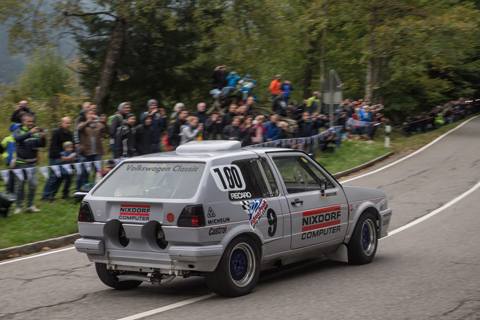
Jochi Kleint crossed the infamous finish line on Pikees Peak at 4,200 meters above sea level on foot. That was 33 years ago, but he still remembers the moment very well. "I could already see the home straight, it was only a few hundred meters to go," says the former racer. But then the impossible happened, a front wheel tore off and blocked the car. Over, over, over. He got out and trudged across the finish line of the Pikes Peak mountain race in Colorado. Back then, a certain Walter Röhrl won in an Audi S1.
The crazy thing about Kleints Golf was the two engines. They sat in front of and behind the monocoque passenger cell, a completely different type of all-wheel drive. Two 1.8-liter four-cylinder engines from the Golf GTI, turbocharged with two exhaust gas turbochargers from KKK, which blew the mixture into the combustion chambers at 1.3 bar. A maximum of 326 hp was available at 7200 rpm, 292 Newton meters of torque at 6400 rpm. All in all, this produced around 652 hp.
The front engine produced a little more power to pull the Golf rather than push it, otherwise it would probably have hobbled up the hill like a rabbit. Two Hewland gearboxes provided the right transmission ratio and a dry sump lubrication system ensured sufficient oil supply. The scales showed the unladen weight of the Golf to be around 1020 kilograms. The top speed was reached at up to 184 km/h, depending on the boost pressure. "The all-wheel drive concept is crazy, but also somehow ingenious," said Jochi Kleint at the time.
Until Volkswagen came along, the record for electric cars on Pikes Peak was 8:57.118 minutes; the track record had been held by Sébastien Loeb with 8:13.878 minutes since 2013. Röhrl still needed 10:47 minutes. However, he still drove this time on gravel, as the mountain track has only been fully asphalted since 2012. Romain Dumas and his VW racer reached the summit in 7:57.148 minutes. New record and late satisfaction.
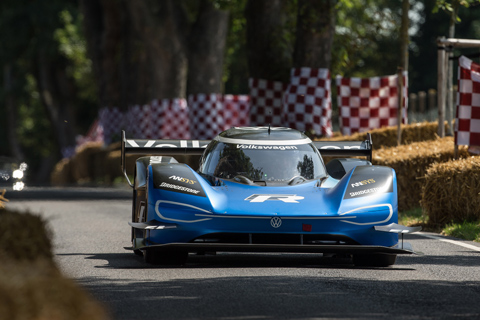
Of course, this time is worlds apart from that of the Golf II from 1987, even if the drive concept is not so different. Under the carbon shell of the new record-breaking car, two electric motors, each with 340 hp and a total of 650 Newton meters of torque, are responsible for propulsion, each driving one of the axles. With this all-wheel drive and a total output of 680 hp, the racing car sprints from 0 to 100 km/h in 2.25 seconds on a dry road and reaches 200 km/h in just 4 seconds. For Jochi Kleint, this must have been almost unimaginable.