From the life of a journeyman mechanic - the sound of the engine
The precise recognition of engine noises and the subsequent targeted elimination of the causes of these noises is a job that cannot always be done in the shortest and therefore cheapest way. Engines of all kinds have an almost unsurpassable ability to generate noise. Although these can be easily distinguished from one another in terms of volume, pitch, frequency of occurrence and many other aspects, it is often extremely difficult to localize them reliably. The best aid here is probably experience. Sufficient experience - usually hard-won and expensive - with the same type of engine allows us to recognize many causes of noise without even having to look under the hood.
But what happens when a new type of engine appears in the workshop? It has a noise that we only know for certain that it would be immediately recognizable in an engine of a known type. However, we can assume with equal certainty that it has a completely different cause.
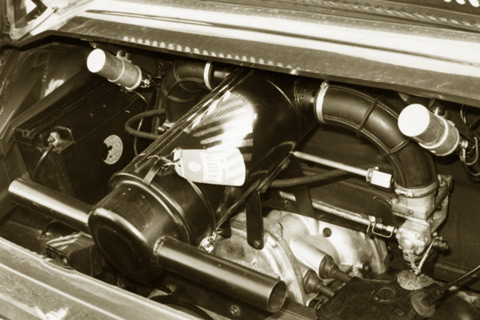
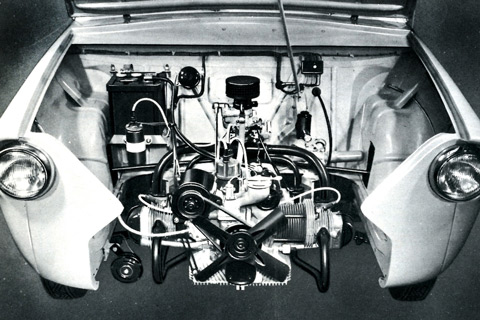
On the occasion of a 10,000 km inspection, we noticed a knocking noise on an engine of the latest design. It occurred at crankshaft speed, but only when the engine was cold and could only be heard clearly when idling. As it was a boxer engine, the first question that arose was - left or right?
If you stood on the right-hand side of the engine, you thought you could hear it clearly on the left. From there, however, you would have sworn it was coming from the other side. Even alternately turning off the ignition and removing the plugs did not clarify this.
We finally decided to go right and dismantled the cylinder head and cylinder. The build-up of oil carbon was considerable for the short running time and the customer's explanation that he had only run on free fuels confirmed our belief that the noise was caused by the heavy carbon build-up. There was no other cause to be found.
But it turned out as we had secretly feared - the engine continued to knock. We found it was even stronger and this time very clearly on the right. As no fairings etc. had yet been fitted, we dismantled the engine again and the piston came down with it. It was examined critically from all sides, and so we didn't miss the tiny bare spot on the underside of the piston skirt, which we now blamed for the knocking noise.
A few strokes of the file removed the spot and the knocking. We then gave ourselves the explanation. When the engine warmed up, the connecting rod grew more than the piston, so the noise only occurred when the engine was cold. But why had it only appeared after 10,000 kilometers? There are probably two explanations for this. On the one hand, the play in the crankshaft bearing and on the piston pin may have allowed the piston to hit, and on the other hand, a slight waxing of the piston skirt can also be considered possible.
The vehicle left us one experience richer, and next time - it will be something else again. Because - Molors of all kinds have an ability that can hardly be surpassed ...
This text was taken from issue 24 of the 1959 edition of the magazine "Krafthand".