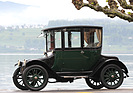
From the life of a journeyman mechanic - steaming car

The question of whether hot water should be poured into a cold engine has often been debated among experts. Well-known works take the view that it does no harm. However, there are often disputes among experts.
However, it will probably depend on the overall temperature difference between the cold engine parts and the hot water to be filled in.
For example, nobody would seriously think of filling boiling water into an engine or radiator that has been standing outside at 10 degrees Celsius! That would be a difference of around 110° C if the boiling water were to flow into the cold cylinder head via the upper water connection. (Normally, the hot water cools down quite noticeably on its way through the radiator, via the lower water connection into the lower part of the engine and from there upwards into the cylinder head, making it harmless).
In our case, it was the other way around. A car came into the workshop and was boiling or steaming "out of every button hole". The customer admitted that he had been driving in this condition for about 10 minutes; because he really wanted to go to the workshop, he would not have done anything about this abnormal condition on the way.
So they switched off the engine and immediately filled up with water. The customer stood by and said: "Wouldn't it be better to fill up with warm water?" "Oh no, it doesn't matter," replied the mechanic and continued to pour water into the radiator quite quickly. We heard one and then another small crack, but didn't attach any importance to it.
The rest of the work requested by the customer was then carried out.
The burst radiator hose responsible for the water loss was also replaced. The customer drove off and the case was quickly forgotten.
But two days later, the customer called again and explained that he could no longer start the engine in the morning. The mechanic who was immediately sent to the customer found that the starter was probably spinning the engine, but that the engine would only start on two cylinders after a long period of "lugging". The other two did not ignite. When unscrewing the plugs, water flowed out of the screw connections. So there was water in the cylinder!
The car was towed to the workshop, the cylinder head was removed - and two cylinders were found to have cracks in the head. Of course, the customer immediately held the workshop liable. Hadn't he heard it crack himself when pouring in the cold water and hadn't he warned about it himself?
But couldn't the head cracks have been caused by driving without water before the water was poured in? That would certainly be possible, but under these circumstances the customer couldn't be persuaded of this with the tongues of angels. Of course, there was noise, anger, and in the end you had to replace the cracked head free of charge if you didn't want to lose a regular customer. If the mechanic had thought things through to the end, he would certainly have remembered the golden rule that you should always agree with the customer if this means that the workshop is less responsible.
If the fitter had immediately heated the water to be filled in, everything would have been fine and nobody would have been blamed. After all, heating the water could have been charged as a time expenditure in the same way as the rest of the working time. You have to be absolutely sure of something if you make claims that this or that is not dangerous or harmless. Otherwise the consequences can be very costly.
This text comes from issue 2 of the 1958 edition of the magazine" Krafthand" .