More or less reliable - a look back at 30 years of endurance testing

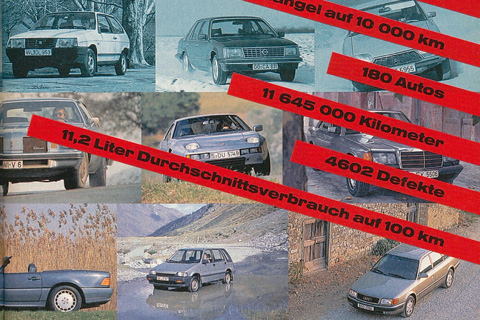
Almost exactly 25 years ago, Klaus Westrup summarized 30 years of endurance testing experience in issue 3/1993 of Auto Motor und Sport . By that time, 188 cars had covered over eleven million kilometers, most of them 100,000 km each, but in the early days the maximum allowed was 35,000 km.
It was to be expected that a lot would happen here, but the table alone of the 85 cars that had covered a six-digit number of kilometers shows beaming winners and sad losers. Of these, a Mazda 626 2.0i GLX from 1989 was by far the most reliable car. It was a car without fault, so to speak. In second place was another Mazda, this time the MX5. And places 3 to 5 also went to Japanese cars. The first German passenger car, a VW Golf Kat (together with the Audi 80 1.9 E.), only came in 6th place. Incidentally, the Porsche 911, which was allowed to complete 100,000 km back in 1975, came in 18th place. Only one of the 25 most reliable cars had to be towed away, the others all completed the distance without a tow truck.
The situation was quite different at the other end of the table. The Citroën CX 2400 from 1978 took 85th place, which had to spend a total of 65 days in the workshop and had to be towed away four times. Only one place better, however, was an Opel Senator 3.0E from 1980, which suffered a major engine failure. Incidentally, the Opel had to be towed away twice.
And even the proverbially reliable VW Beetle only managed 69th place in 1974, its defect index was around 20 times higher than that of the Mazda 626 in first place. At least the Wolfsburg reached its destination without outside help, while the Toyota Landcruiser TD from 1988, for example, had to be towed twice.
Looking through the three endurance test lists (100,000, 50,000, 35,000) brings some surprises and modern drivers can hardly imagine how often they could get into trouble with their car 30 or 50 years ago.
Incidentally, there have also been some curious attempts to test the reliability of cars. In 1981, for example, a Citroën 2CV and a BMW R65 were pitted against each other over 30,000 km. The car came off better than the motorcycle in terms of mileage, mainly because the BMW needed eight new tires over this short distance.
And in 1978, the AMS editors tried their hand at a ten-year-old used car, a 1968 Aston Martin DB6. The experiment ran for 7,000 kilometers and was an expensive pleasure, as DM 10,000 had to be spent over this distance, including fuel and oil. Up to five liters of oil were topped up every 1000 km. "The old one was excitingly beautiful", the testers found at the time, "but also pretty exciting".