It hurts!

As one of the biggest motorsport fans, but also one with a professional background, I'm sad to say that the status of this sport, which used to be super-awesome years ago, is in free fall. Interest is declining almost daily. The number of viewers watching F1 races on television is decreasing from race to race.
Artificial excitement makers, such as double points in the last race, do not help to increase viewing figures. The increase in races to around 21 events per year is just as counterproductive.
Motorsport MUST get back to its roots. 16 races are enough, because that way you can look forward to every single event. The sport must also be simple and easy to understand for everyone. Too many rules that nobody understands anyway only spoil the soup. It must be possible, as in football or ski racing, to tune in in the middle of the race and immediately recognize who, where, how and what is going on.
The TV commentator shouldn't have to spend the whole 110 minutes explaining race after race, rules and regulations, but should be able to concentrate much more on the characters of the drivers and tell exciting or funny background stories.
But wait, unfortunately these stories are also taboo in sport. Nowadays, drivers post everything they say on Facebook themselves and the rest must never be revealed to the public.
Even in the junior formulas, the young future world champions learn how to deal with the media: big talk around the bush without saying anything. Press conferences have become a farce.
It used to be different. I still remember the big gala evening and awards ceremony at my first Indy 500 race. All 33 drivers came on stage in the order of their classification. Everyone praised their team for their great work, regardless of how many laps they could drive with the "suitcase". At that time, Regazzoni sometimes spoke of an "undriveable box" and nobody felt offended in any way. The results always speak for themselves anyway, so the drivers' feigned euphoria doesn't help.
The emotion in the sport has been almost completely lost in recent years, slowly but surely. Today, body control is the be-all and end-all for athletes from an early age. It doesn't matter whether frustration or anger is filling their bellies, they stand there beaming.
Remember the victory ceremony in Imola in 1982, when Didier Pironi stole victory from Gilles Villeneuve. Without any captions, you could see from all the podium photos that Villeneuve was in no way satisfied with the outcome of the race. But today, the victorious drivers even change their clothes to honor him. Even after two hours of extreme exertion in the tropical Malaysian heat, the three of them stand on the podium like one.
It's a shame that scenes like the one in Hungary, when Piquet had to sit down from exhaustion, or Senna in Imola, who had to be hoisted out of the McLaren and only appeared on the podium late. It was even more extreme before the war until the late 1950s, when the winners laughed from the laurel wreath with black faces. Unfortunately, sport is increasingly becoming a marketing event, emotionless and boring.
What actually gave me the idea for this blog? Yes, exactly, the "Credit Suisse Sports Award" last Sunday. What does the one have to do with the other? When the ten candidates for the award were nominated, one sport was completely missing. Wrestlers, skiers, tennis players, cross-country skiers, mountain bikers, handball players, snowboarders, biathletes, triathletes, track and field athletes, gymnasts and ice hockey players were all represented. The now three-time Le Mans winner and former world champion Marcel Fässler was once again absent, as was the newly crowned WEC world champion Sebastien Buemi. How can such athletes be forgotten. I don't think anyone would have forgotten a Siffert or Regazzoni in the seventies, even without Le Mans victories and world championship titles. It hurts my heart to realize that motorsport is losing a lot of its appeal, unfortunately also through the fault of those involved.
I can only appeal to everyone involved: Live and let live, get back to the roots, discuss less, drive more, simpler rules, let the races run their course, accept touches and enjoy the emotions of the drivers. The fans will come of their own accord as soon as real racing is on offer again.
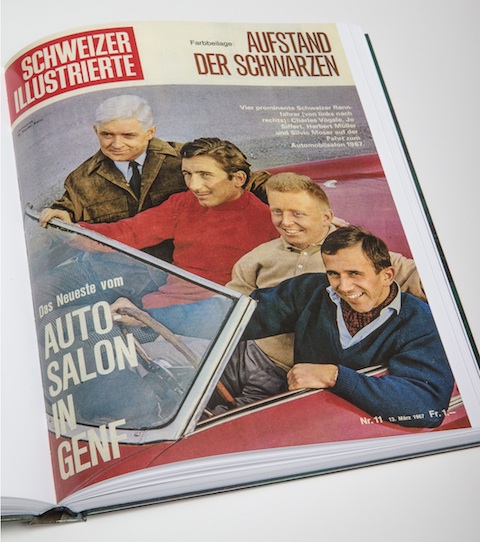
We can probably wait forever for a cover picture of the biggest Swiss family magazine at the time, Schweizer Illustrierte, as shown above on March 13, 1967 with Charles Vögele, Jo Siffert, Herbert Müller and Silvio Moser, with three or four successful racing drivers like Fässler, Buemi and Jani in the car together.