Brake number illumination and press horns for the original Beetle in 1941
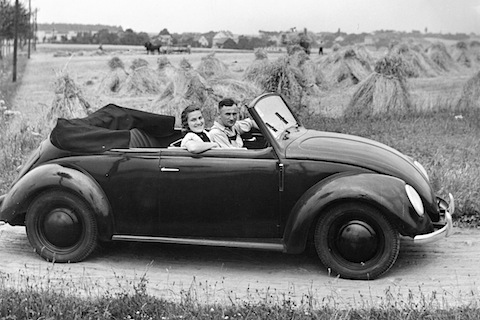
The year is 1941 and German industry is working at full capacity with war production. On the other hand, people are already thinking about what will happen after the war. At this point in time, nobody knows that the war will end in absolute disaster for the German Reich.
The Westfälische Metall-Industrie Aktien-Gesellschaft, or WMI for short, from Lippstadt in North Rhine-Westphalia is also planning for peace in the near future. The company has been around since 1899, when its founder Sally Windmüller produced ball horns, kerosene lamps, horse harnesses and various parts for the newly emerging automobile. In 1908, Windmüller was looking for a "sparkling" name for his newly developed acetylene headlamp. Sally's wife's name was Helene and she was called "Hella". And in the local dialect, the word "heller" is pronounced "hella". Voilà!
We found two papers in our archives that provide an interesting insight into how the project was handled at the time.
Everything is done in three pages
The first documentconsists of three pages, dated July 17, 1941, and is labeled "Order Confirmation" in large letters across the text and "Completion!" in the title. It seems that WMI - the name Hella does not yet appear anywhere - wants to secure the order for horns for the new KdF car, the later Volkswagen, for the post-war period. Or vice versa: the Volkswagen factory tries to retain suppliers. On the one hand, one is surprised at the detailed and somewhat clumsy language. On the other hand, three pages seem to cover all the important aspects such as the number of units, delivery conditions and even the material properties. No comparison to today, where legal departments are kept busy with pages of small print.
Even the letterhead is interesting. It clearly shows that VW "has its hat on". The document was clearly created in Berlin. The Reich capital was the headquarters of Volkswagenwerk GmbH at the time, although the letterhead also mentions the "City of the KdF. car". The name "Wolfsburg" was not used until 1948, and the then still winged VW logo with gearwheel wreath is of course not missing. At least there are no swastikas to be found.
The corpus delicti consists of 10,000 complete license plate lights with integrated brake lights at a total price of 1.72 Reichsmarks. To be more precise, this included 1 housing, 1 lamp holder, 1 washer, 4 hexagonal nuts, 2 spring washers, 1 bulb, 2 ball lamps as well as packaging and free delivery. VW sees this price in the text as a guide price on the one hand, and as an "absolute upper limit" on the other. And they add: "After the 10,000 units ordered today have gone through production, you will be able to see how manufacturing improvements can be made to reduce the target price." Of course, the next batch will be renegotiated, and the payment terms will simply say "ours". So the manufacturer's dictate was no different back then than it is today.
In the further explanations, it is explained that WMI finances the tools itself and is allowed to keep them. And three reference samples, not hand samples, are expected for inspection. Production approval will only be given when "the lamps fit the rear engine cover in every respect". When all this is supposed to happen is described below in the chapter "Peacetime start-up". The definition "after the end of the war" leaves the date open and is intended to secure production capacity for the Volkswagen as decreed by Hitler. In the first year after the war, a further 2,500 units were to be delivered each month, which was to be increased to 12,000 per month by the third year after the war. So the success of the new car was certain, and after the promised victory of the soldiers anyway...
200,000 horns for post-war traffic
A second document dated December 10, 1941, now only two pages long, negotiates the delivery of horns - one of WMI's very own products. To be more precise, these were "complete, 6-volt, pressed-material horns with water drainage holes in the sound shell" at a price of 3.25 Reichsmarks each. In terms of quantity, the company went all out: 200,000 units. And in the first year after the war, a monthly requirement of 4,000 units - and the associated freeing up of production capacity - was also set. In the third post-war year, the forecast was as high as 20,000 units per month.
However, there is also an open point here. The brittle "molded material" is an early plastic that was also used for radios and other electrical appliances, for example. While the latter were never exposed to heat or cold, shocks or stone chipping in the living room at home, the material is considered problematic in the car. VW therefore noted the possibility that "after a certain time, we would like to have the horns made entirely of iron again."
Unsurprisingly, this is also followed by the addendum: "This naturally necessitates a lower price, which we will have to renegotiate in due course." Warranties as we know them today would have ruled out the use of materials known to be brittle in advance. At least the terms of payment are now described a little more precisely: "by the 25th of the month following delivery".
It is easy to imagine how all the purchased parts of the future Volkswagen were gradually negotiated individually and car manufacturers and suppliers prepared for peace in the new great German Reich. Today we know that the economic miracle was many years in coming after the great shambles. The Beetle was extremely lucky. A few kilometers to the east was the beginning of the Soviet occupation zone and thus the future GDR. But fortunately, none of this was known in 1941.