From the beginnings of the airbag

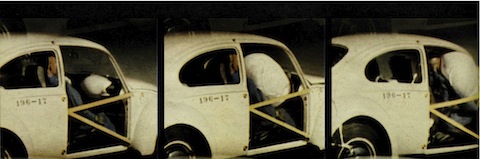
As early as 1967, biophysicist Dr. Clark experimented with airbags to prevent the consequences of accidents in cars and airplanes. However, it would be some time before any truly convincing concepts were presented. In 1970, however, ADAC Motorwelt reported on the "Airceptor", an airbag concept developed by Eaten Yale & Towne in the USA. And this airbag really worked. The bag was made of nylon fabric, nitrogen was pumped into the bag from a bottle the size of a fire extinguisher to inflate it, the sensor was probably still quite mechanical, but only triggered the inflation impulse above 11 km/h and with a sufficiently strong and sustained braking effect. So basically everything was the same as today, only much simpler and much more voluminous .
The tests were positive. The test subjects did not go deaf despite the obviously loud bang. "Around two thirds recovered within 24 hours, all but 5% of the others within a week," said the ADAC Motorwelt report at the time.
Of course, there were still many reservations at the time. What would happen if someone wearing glasses or smoking a pipe hit their face in the airbag? What would happen if the bag was inflated by mistake or if it failed to open in the event of an accident? And how much maintenance would be necessary? The most important question, however, was probably how expensive this bag would be. At the time, Mercedes-Benz estimated 400 to 500 DM per "cushion", while the Americans assumed lower costs of around 70 to 110 DM for large quantities.
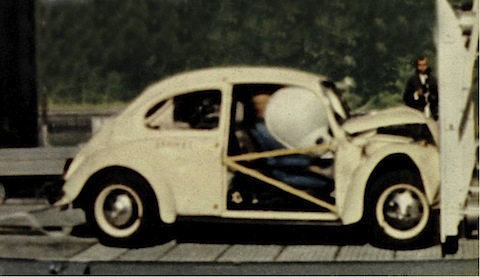
However, the researchers at the time could hardly have imagined that today we have eight or more airbags in our cars, which not only protect the head, but also the knees and all other sensitive parts of the body, and not just in frontal but also in side-impact accidents.