Sports commissioner with floppy hat at the Klausen Race 1929

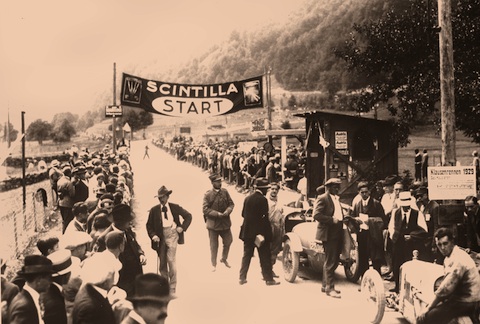
"Klausenrennen 1929" is scribbled in sharp pen on the photo. A ribbon high above the road. It says "Start" and "Scintilla", the leading brand for magnetos. Below it is a wooden booth for timekeepers and their watches. It is designed to protect them from the wet and the heat. The sign "Peddling prohibited" is clearly nailed to a pole. Racing cars, lined up one behind the other, wait for their start time and with them the drivers, mechanics, photographers and journalists.
A Mercedes, two Bugatti, a Maserati and the Alfa Romeo right at the starting line. At the wheel, an Italian, his gaze fixed on the distance. Wisps of fog shroud the starting curve. Its character can only be guessed at: First a sharp right, then an immediate left. Cobblestones. Danger of skidding! The outline of a wall is faintly recognizable. Spectators line the first few meters of the 21-kilometre course. Hundreds! Men in fashionable sportswear with rooftop caps, knickerbockers, walking sticks, motorcyclists wrapped in leather, women with "bobbed hair". A sports commissioner stands at the starting line: tall, spindly, wearing light-colored pants, a white stand-up collar, a gilet with a watch chain and a jet-black frock coat that reaches almost to his knee. A floppy hat covers the right half of his forehead, while the left half is confidently exposed.
A mechanic starts the Alfa Romeo's 8-cylinder engine. A vigorous turn of the crank is all it takes. The engine wakes up, at first reluctantly, stuttering, then humming quietly. The inspector with the floppy hat is still blocking the way to the finish line. Now he counts the last seconds. Ten more, nine more. The young Italian depresses the gas pedal, the eight cylinders roar to life. The whole car vibrates, shakes, and with it the road and the spectators. One blast of gas follows the next. An infernal staccato. Five, four, three - the driver engages first gear - two, one, go! The spindly man holds on to the floppy hat, takes a step back and releases the track. The clutch engages. The drive wheels spin wildly on the loose gravel.
But the Alfa Romeo won't budge. It's as if an invisible person is clawing the wild Grand Prix racing car's fingers into the rear, jamming its spindly legs into the road dust and preventing it from driving into the dense fog. Now - he lets go, a jerk and, as if snatched from the sinew, the car hurls itself wildly onto the starting straight. The spectators recoil in horror. 200 hp rushes the Alfa Romeo towards the wall of fog. It is swallowed up by it. What remains is the sweet smell of burnt castor oil.
The deafening screech of the compressor echoes out of the fog - amplified many times over by the limestone walls encircling Linthal. The first bend seems to have been mastered.
Then the sound stops. Suddenly. For a moment there is dead silence. Paralyzed, the spectators stare after the missing racing car. But the fog reveals nothing. Nothing! Has it stifled the scream and the pain? The first spectators jump up, run across the road, want to help, to save. They call for paramedics, for the doctor. The race is stopped. The engines fall silent. An ambulance races off. A second one. And suddenly they are there. Out of nowhere, the rubberneckers eager for sensation. They obstruct the rescuers, block their way.
The spindly sports commissioner with the frock coat that reaches almost to his knee pushes his floppy hat down low on his forehead, ducks down, looks to the left, to the right and disappears silently into the crowd with soft footsteps....