The other Italo-Opel of the nineties...

...was presented almost exactly five years before the Bertone Slalom . Although Bertone had been building the Kadett convertible since 1987, it was Pininfarina of all people who pioneered the special bodywork on a modern Opel.
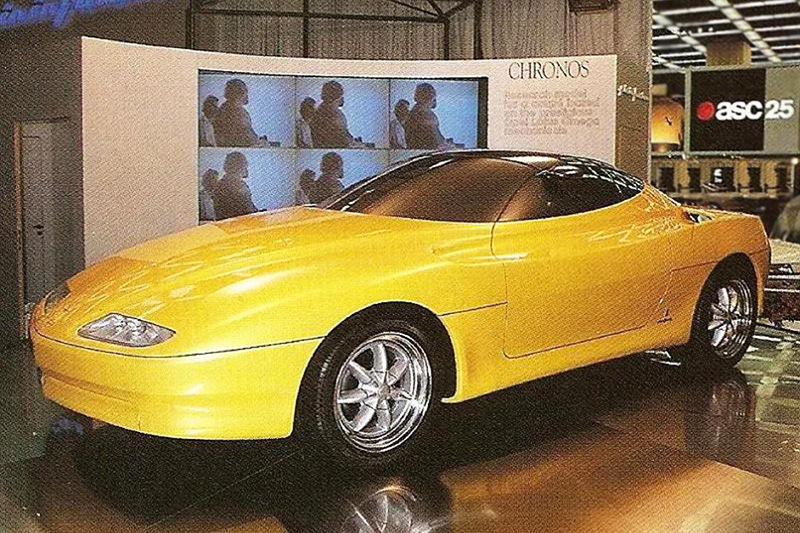
To honor 60 years of cooperation with General Motors, the traditional Turin-based company unveiled the Pininfarina Chronos at the 1991 Geneva Motor Show. Although the first joint project was a Cadillac V16 in 1931 and the company had been producing the bodies for the Allanté since 1987, the Italians decided against a technical basis from GM's top brand.
Instead, the yellow coupé was based on the floor assembly of the Opel Lotus Omega, which had been shortened by 28 centimetres. In addition to classic rear-wheel drive, this also meant: six cylinders, 3.6 liters of displacement and 382 hp, thanks to which the Chronos could reach speeds of up to 282 km/h. However, the link to German technology and English refinement ended right there.
In contrast to the Bertone Slalom, the Pininfarina Chronos had very little in common with previous and - as we know today - future Opel design language. Where the Slalom emphasized the triangle and the edge, the Chronos curated by Lorenzo Ramaciotti consisted almost exclusively of ellipses and curves. It was not even allowed to carry the lightning bolt.