50 years of forced-breathing automotive history experienced in three hours

It's not every day that you get the opportunity to explore the automotive development of the last 50 years in a direct driving comparison. Now we are not talking about general vehicle development here, but about Porsche cars with the additional designation "Turbo", i.e. with forced-induction combustion engines. There was one exception, but more about that later.
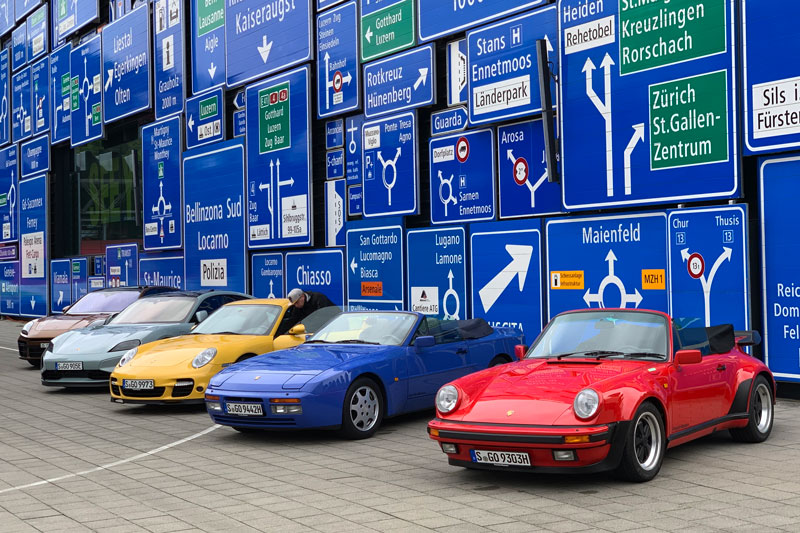
Porsche Switzerland invited people to the test drive and provided five cars.
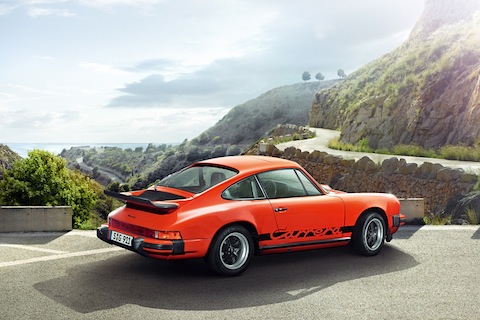
The first was a late Porsche 930 Cabriolet, which marks the beginning of Porsche's turbo history, so to speak, and is also the reason for the "50 years of Porsche Turbo" anniversary celebrated this year, as the production version of the Porsche 911 with turbocharger was presented at the Paris Motor Show in the fall of 1974. Although the displacement increased from three to 3.3 liters (300 hp) and the number of gears from four to five by the end of the production period (1989), even the last cars in the series give an idea of what the first 930 must have felt like. Although the original Turbo may have lost some of its stability as a convertible, the open roof and thus the even more direct access to the soundscape definitely compensated for this from our point of view. The turbo boost, which kicks in with all its might from around 3500 rpm, is addictive together with the background noise. And in coasting mode, the exhaust noise is pleasing with those sounds that only vehicles from back then offer. Otherwise, the 930 is simply a classic 911 as we were used to, just with more thrust.
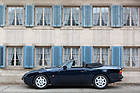
Switching to the Porsche 944 Turbo as a convertible opens up a much more modern world of cars. The power steering makes the four-cylinder sports car easy to handle, the cockpit exudes the charm of the 1980s rather than the 1970s. However, the 250 hp 944 Turbo still has to draw in a lot of air before it fires off at around 3000 rpm and more often than not you find yourself in first gear of the easily shiftable five-speed gearbox, especially when going uphill. It's fun and the sound is pleasing, even if it's not as characteristic as that of the 930.
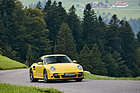
We took another leap forward into the new millennium and boarded the 997.1 Turbo. The engine is still started with the ignition key and the water-cooled 911 is impressive from the very first few meters. It is still compact enough to be a pleasure to drive on narrow mountain passes, but takes off like the proverbial scorched pig. No wonder with almost 500 hp and all-wheel drive. In fact, the 997 is even around 40 kg lighter than its predecessor. The car we drove was (unfortunately) equipped with Tiptronic, which certainly takes away some of the driving pleasure compared to the manual gearbox still available at the time, but there is still enough dynamism left. The way in which the 997.1 can dash off and weave its way around bends is first class. The steering provides plenty of road contact and the chassis is comfortable and at the same time responsive. The engine emits a wonderful background noise and after just a few meters you understand why the 997 Turbo is also finding more and more friends on the classic car market.
The next change brings us into the modern era. A Panamera Turbo e-Hybrid is probably not exactly the dream car for sports car and classic car fans, but this car should not be underestimated. A total of almost 700 hp is available at the four wheels, and the supercharged V8 works so efficiently with the electric motors that the unladen weight of around 2.4 tons is quickly forgotten. However, one cannot and should not forget the dimensions of the car, which is over five meters long and almost two meters wide. Of course, the modern Porsche is started at the touch of a button (preferably to the left of the steering wheel), and the gear is selected using a large toggle switch to the right of the steering wheel. But you have to find it first. So that the typically somewhat older owner can easily get in, the Panamera rises a few centimeters when the door is opened.
Our harbinger of the future, the Porsche Taycan Turbo GT, which was the last of the five cars we were invited to test drive, can also do this. With it, we have arrived in a completely different era. Both the thrust (over 1000 hp, up to over 1200 Nm torque) and the chassis finesse seem to come from another world. The way this 2.4-tonner turns in, but above all the way it takes off at the touch of the pedal without any delay, is quite an experience. The background noise can't keep up with this and it's best to enjoy the Taycan as silently as possible or simply let yourself be lulled to sleep by the music system. The Taycan feels at home everywhere and impresses in every second, but it can't quite replicate the fascination of a 930 Turbo, especially when you look at the LCD displays.
Five interesting cars from 50 years of Porsche Turbo. The fact that the "Turbo" has become a marketing term in the Taycan at the latest is something you just have to accept, especially as there are only a few exceptions to the idea of a turbocharger in modern combustion engines.
And as Mezger, the Porsche engine developer, said: "Performance is never the problem with a turbo engine, driveability is. The progress that has been made here in 50 years is impressive, as the five (or rather) four Porsche Turbo models have impressively demonstrated.
P.S. Incidentally, the cars were all (with the exception of the Taycan, logically) refueled with eFuel. You didn't notice any of this (of course), after all, the ecological alternative to fossil gasoline burns just as well and just as thoroughly. Only the refueling by canister was a little more time-consuming ...
_RM.jpg)