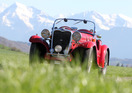
With the Brütsch Mopetta at the start of the 1957 24 Hours of Le Mans
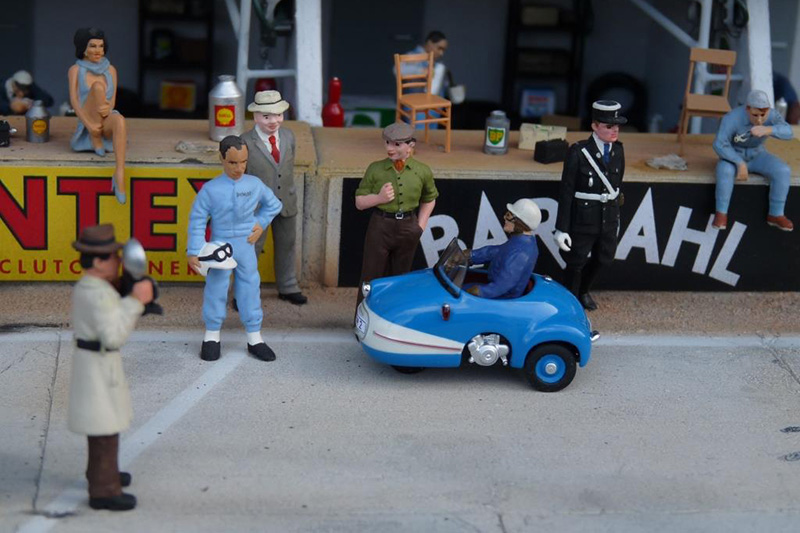
Today, the Brütsch Mopetta from 1956/57 is considered the smallest series-produced car in German post-war history. Well...in series production? In fact, only 14 vehicles were produced, which also differed in details. A planned series production ended up in the dustbin of history in 1958. Nevertheless, the Mopetta has a similar status in Germany to the British Peel P50, with which it competes for the smallest car in the world.
In 1951, Brütsch created his first microcar, the "Hermit", followed by a whole cascade of microcars, from 1954 with plastic bodies (GRP half-shells), inspired by the first Corvette of 1953. The best-known model apart from the Mopetta was the "Spatz", on the basis of which the Victoria Spatz was later created, which nevertheless achieved a small series of 1500 vehicles.
A detailed report on Egon Brütsch and his small car designs was recently published here.
Mopetta or Peel - which is the smaller car?
Today, the Peel is actually considered to be the smallest automobile built in series. But was the Peel really the smallest car - or was it the Mopetta? In any case, a comparison of the dimensions does not provide a clear result. Another criterion could decide the matter: After all, around 120 examples of the Peel were produced, making it a genuine small series, whereas the Mopetta, with its 14 vehicles, can hardly be considered a series production.
Brütsch Mopetta at Le Mans in 1957
However, the Mopetta had one thing over the Peel: a start at the 24 Hours of Le Mans.
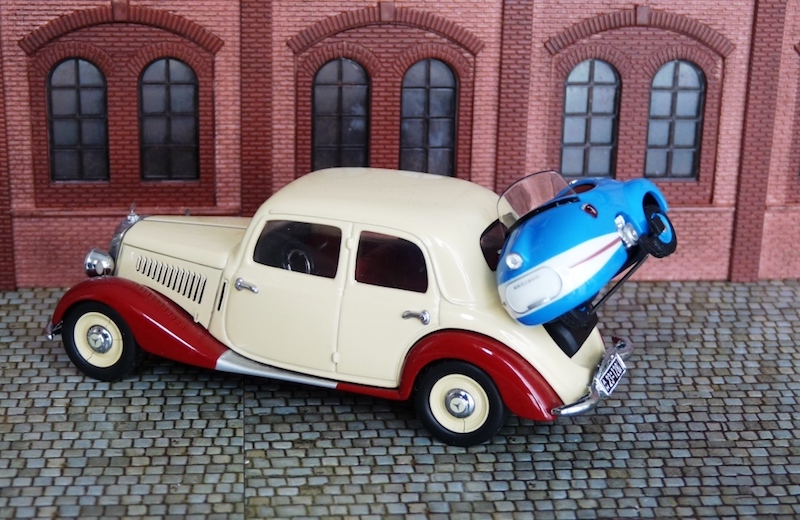
One can only speculate as to the reason why there is no reference to the Mopetta's participation in the 1957 race in the extensive Le Mans literature.

With a bit of luck, I did find something during one of my last visits to the race in the old town of Le Mans: In a second-hand bookshop for books and journals, I found two articles in old French magazines about the 1957 race, garnished with some black-and-white photos showing the Mopetta during training and the race. The pictures shown here are model reconstructions of these black-and-white photos, which unfortunately cannot be published for copyright reasons. The following could be reconstructed on the basis of the old texts:
In 1957, the organizer of the 24 Hours (Automobile Club de l'Ouest, ACO) created a new displacement class up to 50 cc (miniature sports cars, "Voitures de Sport le Plus Petit") in order to do justice to the then current trend of "microcars". However, a lone Mopetta was the only entry for this new category, which is why the vehicle did not receive a start number. The names of the two drivers could not be determined, but it can be assumed that Egon Brütsch, who raced himself at the end of the 1940s, was at the wheel.

The Brütsch team made some changes to the Mopetta: The engine power was increased to 3 hp, and a larger tank (25 liters) was also installed so that it could be used to cover around 800 km of racing distance - the petrol/oil mixture was therefore sufficient for 16 hours at an expected average speed of around 50 km/h. It was hoped to achieve a total distance of over 1000 km in the end.
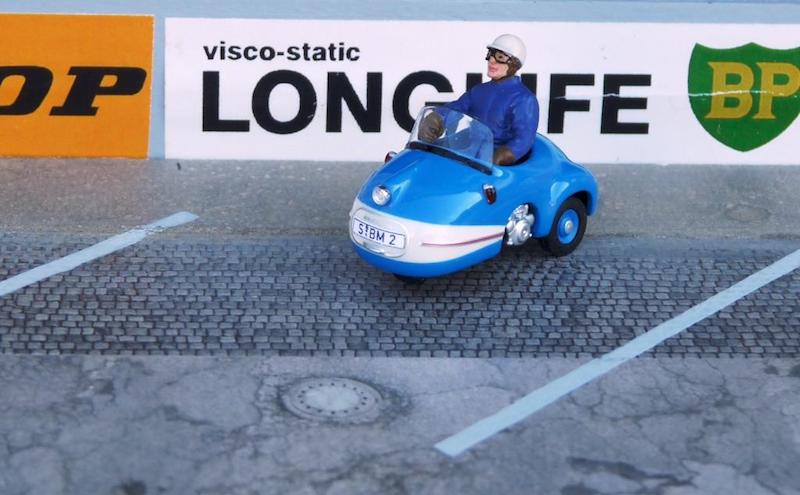
Incidentally, the larger tank under the driver's seat required the rather high seating position visible in the photos. However, this was necessary anyway, as the Plexiglas windshield without windshield wipers prevented a good view to the front, especially in the rain, so that the drivers preferred to look over the edge of the windshield - this was also common in the large open sports cars at Le Mans at the time.
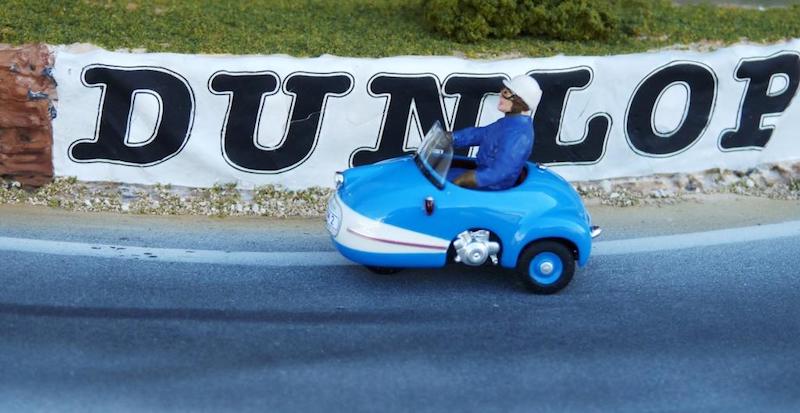
Unfortunately, the Mopetta's appearance was not as successful as planned. Although they complied with the demands of the race organizers and always drove on the very edge of the race track, many drivers of the big cars complained about some critical situations due to the speed differences. However, these problems were resolved after around three hours, as the Mopetta unfortunately failed to start during the first driver change and was subsequently withdrawn from the race - what a shame!
After these experiences and in view of the poor response to the new class, the ACO decided to dispense with a small sports car class after 1957 and to delete all facts about the Mopetta guest appearance from the official statistics.
This article also appeared in a similar form on the "Minerva-Endurance " website .