Fewer new classic cars in the future (question of the week)


Cars are becoming increasingly complex, materials and their combinations more elaborate, electronics are omnipresent. The supply of parts is becoming more critical and dependence on manufacturers is increasing. Do cars built between 1998 and 2005, which were once inexpensive and produced for the masses, have any chance of surviving on the road in 20 or 30 years' time? Will there still be a VW Golf IV or a Citroën Xantia on the road in 2040 or 2050? We wanted to find out with a "question of the week" .
Zwischengas readers are relatively unanimous when it comes to this question.
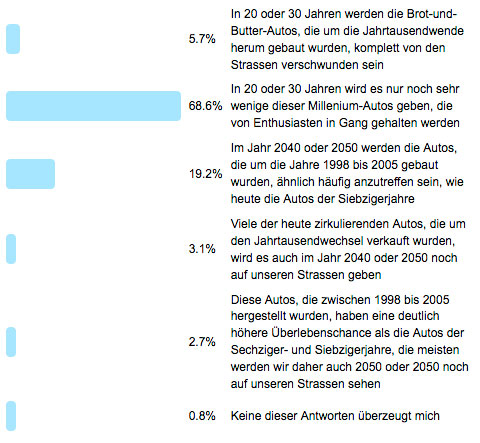
68.6 percent of the 261 respondents believe that in 20 or 30 years' time there will be very few of the cars that came onto the roads between 1998 and 2005.
19.2 percent are somewhat more optimistic and think that cars built around the turn of the millennium will be seen on the roads in 2040 or 2050 with a similar frequency to vehicles from the 1970s today.
3.1 percent even assume that many of these millennium cars will still be in circulation in 20 or 30 years' time and 2.7 percent even believe that these cars were actually well built and therefore have a significantly higher chance of survival than those from the 1970s. 0.8 percent were unable to answer any of the questions.
But if you believe the almost 70 percent, then the influx of new classic cars will probably start to decrease in 10 to 20 years, so that perhaps there will be fewer young classic cars on the roads than old ones.
Here is the analysis in graphic form:
Of course, we have already posed the next "question of the week" . Now we would like to know whether our readers think that hypercars will continue to be highly valued in the future?
And of course you can read all previous evaluations of the now more than 160 questions of the weekin the corresponding topic channel.