70 years of F1 from the perspective of Mercedes Benz

Normally, a Grand Prix bears the name of the country or region in which it is held. This weekend is a little different, because instead we are celebrating a very special milestone: the 70th anniversary of the Formula 1 World Championship.
The sport has changed a lot since the first World Championship race in Silverstone in 1950 to Formula 1 as we know it today. However, the spirit of Formula 1 has remained unchanged: the best cars and drivers compete against each other to fight for victories and world titles on the race track.
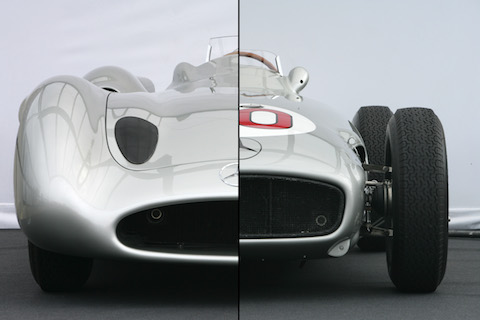
Over 66 years ago, Mercedes made its Formula 1 debut at the 1954 French Grand Prix with the breathtaking Mercedes-Benz W 196, a car that would soon be known for being ahead of its time. The Silver Arrow took Formula 1 by storm from the very first race, winning a total of nine of the twelve Grands Prix in which it competed in 1954 and 1955.
To celebrate this weekend's remarkable F1 milestone, we take a close look at our first Formula 1 car, the W 196:
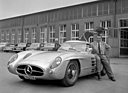
- The W 196 was used in two variants during its time in Formula 1: the "monoposto" with free-standing wheels and the "streamlined" version with full bodywork, which was optimized for high speeds on the straights.
- The "streamlined" version of the W 196 became an absolute legend in racing history, although the "monoposto" version took part in more races.
- The "streamlined" version of the car was used in the first two races of the 1954 season, while the "monoposto" only made its debut in the third race.
- During its short but highly successful time in Formula 1, a total of 14 W 196 vehicles were built, including the prototype.
- The "streamlined" version of the W 196 won the French Grand Prix in 1954 and the Italian Grand Prix in 1954 and 1955, the only three Formula 1 races to be won by a car with full bodywork.
- It was the first Formula 1 car with direct injection (the fuel is injected directly into the combustion chamber instead of the intake manifold) and force-controlled valves (the engine's valves have two cams and two actuators, each for controlled opening and closing of the valves without a spring).
- The 2.5-liter 8-cylinder engine of the W 196 produced up to 256 hp in 1954. This figure was increased to 290 hp for the next season. The car achieved top speeds of more than 300 km/h.
- In order to better adapt the car to certain tracks, the W 196 was used with three different wheelbases in the 1955 season. The shortest wheelbase was specially developed for Monaco, but was also available on other circuits.
- In the course of the 1955 season, Mercedes was able to reduce the vehicle weight by around 70 kg.
- The difference between the chassis of 1954 and that of 1955 can be clearly seen, as the 1955 car has an air scoop at the front right.
- Juan Manuel Fangio was at the wheel for eight of the W 196's nine victories. The remaining victory was achieved by Sir Stirling Moss at the famous 1955 British Grand Prix, in which Mercedes clinched a quadruple victory.
- Just a few weeks after the 1955 Argentine Grand Prix, Juan Manuel Fangio scored another victory in a non-championship race in Buenos Aires in a W 196 equipped with a 3-liter engine. Mercedes used the race with open regulations to test a new engine, which was later used in the Mercedes-Benz 300 SLR.
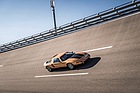
- The Mercedes-Benz 300 SLR racing car from 1955 was heavily based on the W 196. The two cars shared many components, but the Mercedes-Benz 300 SLR used a two-seater sports car body.
- Only four Formula 1 teams were able to win their debut race: Alfa Romeo in 1950, Mercedes in 1954, Wolf in 1977 and Brawn GP in 2009.

- GP Bern 1954 with Fangio, Kling and Hermann
- Klausen Race 2002 with Jochen Mass (picture
- GP Tell in Lucerne with Rico Steinemann

_RM.jpg)