Jim Clark: The mysterious death of an invulnerable man on April 7, 1968

At exactly 12:39 pm 50 years ago today, motorsport lost its greatest talent at the time. Jim Clark, the likeable Scottish steering wheel virtuoso who was second to none, died in mysterious circumstances during a Formula 2 race in Hockenheim. He was actually supposed to drive a Ford sports car of the Alan Mann team in Brands Hatch, but the first real sponsor in motorsport, the tobacco company "Gold Leaf", which determined the color of a racing car for the first time in 1968, wanted the two Lotus GP drivers of the time, Jim Clark and Graham Hill, to perform their services at the Formula 2 race in Hockenheim.
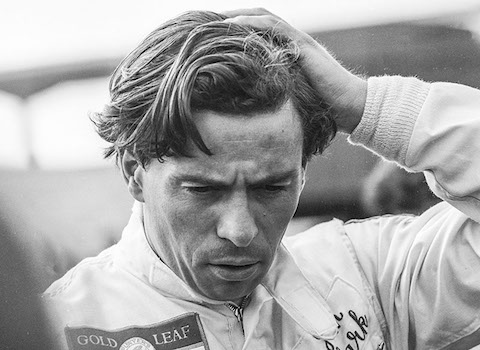
However, the weekend was a very bad one for the "Gold Leaf Team Lotus", as both of Colin Chapman's cars were unable to cope with the track and the cold, wet weather. Engine misfires as a result of problems with the ignition and mixture preparation plagued both drivers during practice and drove them into spins more often than they were used to. Jim Clark, a two-time Formula 1 world champion, had just replaced Juan Manuel Fangio, who had previously been best in class, in the all-time list of GP victories three months earlier. The Scot won the South African GP, securing full points for the 25th time. With this magnificent triumph, he made it clear at the opening race that he had already set out on the road to his third world championship title, after 1963 and 65.
However, Clark was only able to start the Formula 2 race from 7th on the grid, 2.4 seconds behind the fastest driver in practice, Frenchman Jean Pierre Beltoise. The race started in a light drizzle and Clark was unable to intervene in the race in his Lotus 48 until the accident. He was stuck in eighth place between Chris Lambert and Robin Widdows, around half a minute behind the German Kurt Ahrens, who was leading at the time.
The serious accident in lap 5 at kilometer 2.1 on the long, slightly curved forest straight towards the eastern bend could never really be analyzed. The track marshal Winfried Kolb, one of very few eyewitnesses, saw how the rear of the Lotus first swerved to the right at the rear and then, after two counter moves, triggered a 45 degree angle take-off into the then still unsecured forest. As Clark frantically tried to bring the Lotus under control over a distance of around 300 meters, he hit the trees at almost undiminished speed. The car was cut into three pieces and Clark was almost certainly killed on the spot. In order to avoid the prosecution at the scene, Clark was taken by ambulance to Heidelberg University Hospital, where only his death from a broken neck and base of skull could be confirmed.
Why the racing icon, who was believed to be invulnerable, was killed in a racing car with "only" 230 hp and a speed of around 260 km/h is still a mystery today. Since a driving error by a racing driver the size of Jim Clark on a practically straight track can be ruled out, a suspension break, a steering defect, aquaplaning or even an engine failure, but in the end most likely a tire failure. At the behest of Colin Chapman, all the wreckage was brought over a small Belgian border crossing to England in a night and fog operation, where Peter Jowett, an expert on plane crashes, was commissioned by Lotus to take a close look at the wreckage and in the end he confirmed a cut or tear in the tread of a tire.
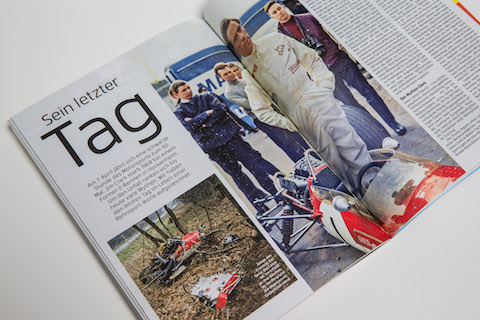
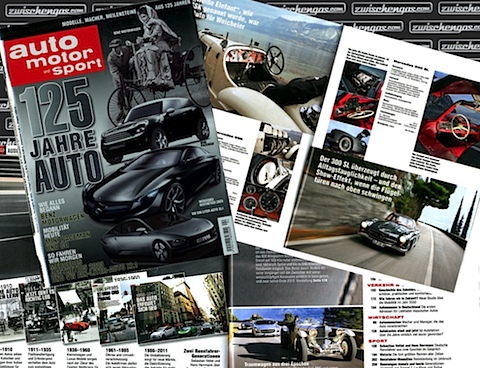
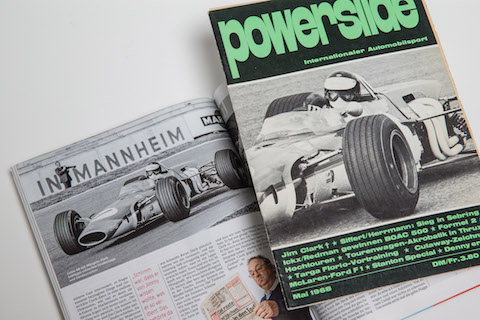
My father, Josef Reinhard, better known in Switzerland as "Katastrophen-Sepp", was at the F2 race in Hockenheim on April 7, 1968 as a photographer for the then unique motorsport magazine "powerslide" by Rico Steinemann. He took pictures that later went around the world and, as you can see, are still finding their way into the biggest German automobile magazine "Auto, Motor und Sport" after 50 years. Shortly before the start, he took portraits showing Clark, who was always smiling, looking very thoughtful for once. When he heard about the accident, he left the racing action behind and ran the two kilometers or so to the scene of the accident, where he was able to take various pictures of the three-part Lotus.
Once again, we would like to draw your attention to the uniqueness of a membership with zwischengas.com. An article can always arouse your interest and you would like to find out more about it. With the help of our magazine archive, you can do your research on the spot. Using Jim Clark as an example, we show you what else you can read about his unexpected death on April 7, 1968, apart from this article.
These links (just click on them) will take you directly to the pages from our magazine archive.
- Auto, Motor und Sport No. 9, 1968, page 64and page 84
- Powerslide No. 5, May 1968, front pageand page 5
- Automobil-Revue No. 18, April 11, 1968, page 2and page 9
Incidentally, our German-language online magazine archiveis the largest in the world. Over 350,000 digitized magazine pages can be used for research with a full-text search. To be able to read the texts you need at least a Premium Light membership( EUR 24, CHF 26 per year). If you would like to archive individual journal pages as PDF files for private purposes, you will need our Premium PRO membership.