Fit at the wheel - keep fit

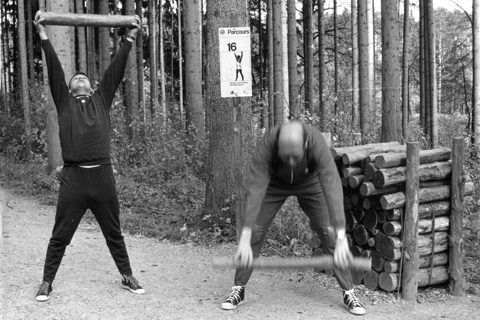
In Switzerland they were called Vitaparcours, in Germany they were called "Trimm-dich-Pfad". The concept, invented in the late 1960s, was simple: you used wooden elements and logs to stretch your body and activate your muscles. You ran between the posts, which were explained on easy-to-understand boards, and thus did something for your health and fitness.
Automobil Revue also wrote about the Vitaparcours in 1971, because it allowed individual training and thus offered an excellent opportunity to strengthen muscles and circulation without having to join a club with fixed training times. And this is particularly important for frequent drivers, whose spine is condemned to inactivity and whose arms are no longer challenged due to the ever decreasing power required for steering.
For those who did not want to visit a Vitaparcours, the Automobil Revue, or rather Dr. Baumgartner, suggested training directly at the steering wheel:
- The cervical spine can be moved by tilting and turning the head. The driver's gaze remains on the road, so that the eyes also indirectly benefit from a welcome relaxation exercise.
- The thoracic and lumbar spine can also be moved during the ride through rotational movements, as practiced when walking and especially when skiing. Rhythmic shifting of the pelvis and simultaneous movement of the shoulder girdle allow the torso to rotate around the longitudinal axis by 20 to 30 degrees.
- If the arms can be supported at the side - although this requires armrests on both sides - the spine can also be stretched, which has a particularly beneficial effect.
- By alternately raising the pelvis to the left and right, the spine can also be moved sideways to a certain extent.
- The arms do not need to constantly cling to the steering wheel. There are traffic situations where it is perfectly acceptable to steer with one hand only and actively move the joints of the other arm during this time: it is best to proceed systematically, starting with the fingers and ending with the shoulder joint.
- Even the joints of the left foot can be loosened from time to time by moving them up and down and using circular movements. The knee and hip can also be moved as far as possible. The situation is worse for the right foot, which must not leave its position on the accelerator or brake pedal under any circumstances. After a long journey, it is this foot that has to struggle the most with a feeling of heaviness, signs of fatigue, falling asleep or even cramps.
Yes, almost 50 years ago, nobody thought of mass-produced seats or even semi-autonomous cars ...
P.S. The Vitaparcours still exists, unlike its namesake and sponsor, the life insurer Vita. It has been called Zurich Life for over 20 years ...