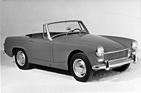
Something is only original if it really is original (question of the week)


There are probably few terms relating to old cars that are discussed and debated with as much vehemence as "original". You could make it easy for yourself and say that a car is only original if it corresponds exactly to the delivery condition in all facets (right down to the paintwork and wearing parts), i.e. that nothing has ever been done to the vehicle. But this would presumably make any driving impossible. Over time, therefore, more liberal definitions or opinions have prevailed, which also give "lived-in" cars the chance to still be described as "original".
As part of a" question of the week" , we put a number of possible definitions to our readers in order to understand how "originality" would be understood today. Over 330 responses were received.
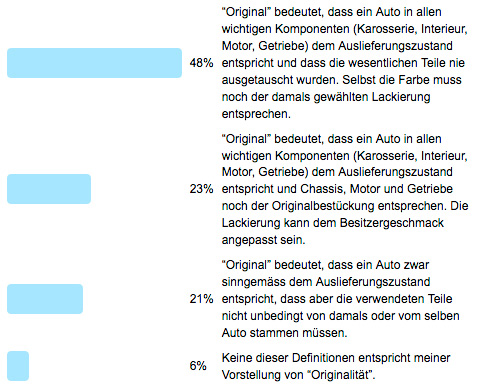
Almost half (48%) prefer a fairly narrow definition of originality, i.e. that a car would have to correspond to the delivery condition in all important components (body, interior, engine, gearbox) in order to be considered "original". In this case, even the color would have to match the delivered color.
Almost a quarter (23%) would be prepared to accept compromises in the color and also in the interior and body details as long as the chassis, engine and transmission are still those with which the car was delivered and the body and interior are close to what was once built.
At most, around a fifth (21%) demanded that a car should correspond to the condition in which it was delivered, but that the parts should not necessarily be from the same car at the time.
A further 6% were unable to agree with any definition. One reader wrote to us: "I noticed that you completely omitted a very important aspect in your question, which is an essential part of assessing the authenticity of a vehicle. The "continuous history", i.e. the proven continuous history since the vehicle was delivered."
Of course, this could be discussed at length. Is the history necessary to verify the authenticity of the car and its parts or is it part of the car, so to speak?
Other readers found the whole question superfluous anyway.
Here is the graphical result of the survey:
The next question of the week is already underway, which is about 3D printing and its role in the spare parts procurement of the future .
And of course you can still read all the previous results of the "Questions of the Week" in the corresponding topic channel.