Under the title "Renaissance of the two-seater?", Ernst Behrendt wrote an entertaining report in the Automobil Revue in March 1981, which should be a real textbook example of how things can go wrong if you give customers too much credit for knowing what they want. So let's start with the text from USA correspondent Behrendt:
"Ford Motor Company believes it has discovered a gaping hole in the market, and into it it now swings with elegance. Today, the diagnostic tool for finding a gap is called "demographics"; just yesterday it was called customer profiling and the day before yesterday it was simply called market research.
It all comes down to pretty much the same thing, namely the question of how large the population group is that could buy what kind of cars under what circumstances. At Ford, the "demographics" experts (and that's not quite the same as demographers) found that the group of "singles", i.e. those who are not yet married and those who are no longer married, has almost doubled in less than 20 years. They also found that 40 percent of new car buyers today - up from 28 percent 20 years ago - are under the age of 35 and that many of them have few or no children or are unmarried. There is another 40 percent group: women. They buy 40 percent of new cars (but only 15 percent just two decades ago), and when it comes to who is behind the wheel of new cars, the figure is almost 50 percent.
The "demographics" people also found out a few other things: that more than 50 percent of drivers who want to buy a new car "think small" - it was around 25 percent twenty years ago - and also that unmarried people, young men, young women and the "mini-households" in general (for example: Very small families, but the partners need not necessarily be married) consistently want cars that are real fun to drive in ("fun-to-drive cars"), if, and this should be emphasized, such cars are available and affordable. But such, shall we say enjoyable, small cars are also, Ford says, increasingly coveted by drivers who are no longer in their first and second youth, by members of the professions, by the countless commuters and by all the millions who need two or more cars (32 percent of all American families have at least two cars).
Once the "demographics" people had done their schoolwork, it was actually quite clear what kind of car Ford Motor Company could, and should, produce profitably. There were obviously vast hordes of unsatisfied buyers, and once you had plowed through their wish lists and studied their financial situation, the vision of a relatively cheap, pleasing to look at, economical to run, reliable, easy to drive car almost inevitably emerged (funny: it's all very reminiscent of specifications in the demand and supply lists of old-fashioned marriage brokers and modern matchmaking computers). If you listened even further to the voice of the people - and in the "demographics" department this was done - then you could also clearly hear tones of nostalgia: "Yes, those were the days when there were two-seaters like the original Thunderbird. .."
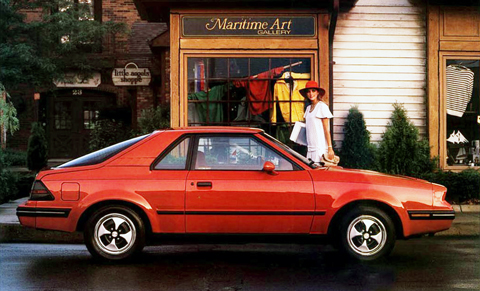
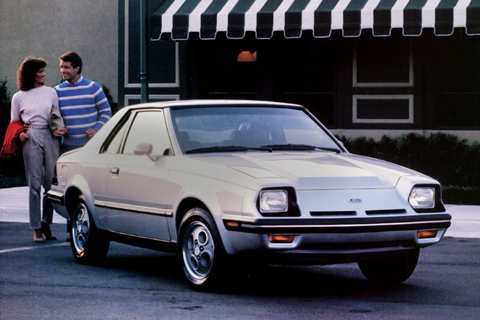
In short, Ford had spotted the gap in the market and, using the chassis of the successful Escort and its Mercury twin, the Lynx, built a sporty (not: sports) two-seater; in the Ford "division" it is called the EXP, at Lincoln-Mercury it is the LN7.
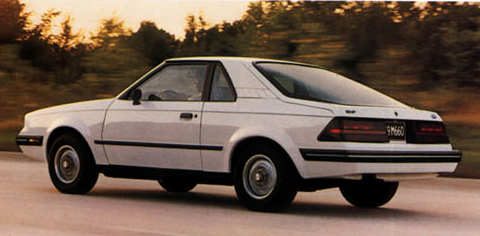
![Ford EXP von 1985 von der Seite]()
The EXP and LN7 will be launched in America at the beginning of April. The sales price has not yet been set; it is likely to be between 7000 and 8000 dollars. By the way: the names and model designations don't mean all that much. The group of letters EXP was chosen, as a Ford official mentioned en passant, because "experimental" also begins with these three letters and the public could thus get the feeling of experiencing the motto "With the car into the future" à la Geneva Motor Show. The ground beneath LN7 shakes even more. LN, it was said, was chosen in reference to Lynx ( = lynx) - and the 7 simply because 7 is a lucky number.
The EXP and the LN7 are twins, but not identical. Apart from the radiator design, the main external difference is that the rear window of the LN7 has been extended to form an enormous glass dome, a "bubble", as the official description puts it, which has several properties: it enlarges the luggage compartment, improves the wind resistance (the Cd value of the LN7 is given as 0.36, that of the EXP as 0.37), gives the vehicle an unmistakable characteristic and improves visibility to the rear and to the sides.
The LN7 also offers a little more on the inside: a richer interior, pleasant little additional devices such as a trip odometer, a digital display that shows not only the time at the touch of a button but also other data, and so on. Obviously, the extremely streamlined design pays off: the Environmental Protection Agency (EPA) was able to certify both models with a fuel consumption of 29 mpg in the city and 46 mpg on the highway as well as a combined 37 mpg, i.e. 8.1, 5.1 and 6.4 liters/100 km respectively. (For comparison: the official standards for 1981 models stipulate a CAFE [corporate average fuel economy] of 22 mpg = 10.69 1/100 km in mixed city and country road traffic).
![Ford EXP von 1985 von hinten]()
EXP and LN7 are therefore unprecedentedly frugal. The normal maintenance costs are almost microscopic. Calculated over five years and 50,000 miles (80,000 km), they should amount to a total of just 150 dollars and take barely more than an hour's work per year.
The driving characteristics of the new Ford/Mercury offspring are very pleasing. On the sometimes romantic, sometimes somewhat risky roads in the foothills of Arizona's Superstition Mountains, which are criss-crossed by many hollows (actually dry streams), the LN7 followed the slightest hint of the steering wheel; it never happened, as in the legend of the horse-general, that the rear end wanted something different from the front end. The suspension was refreshingly firm, but not too hard. In this respect, the vehicle delivered on its promise of being a sporty car that is a lot of fun to drive. Add to this the fact that the brakes give a feeling of absolute reliability, and the ideal seems almost achieved.
When overtaking and on inclines, however, it quickly becomes apparent that the 1.6-liter OHC engine with its 71 net horsepower is more likely to wheeze than a powerful V8 from earlier times. Even in third gear (there are only four, but a five-speed gearbox could be added later), the temperament is not particularly pronounced: you have to go down to second and then immediately notice that the gap between two and three is very large. The EXP and the LN7 will probably be equipped with an automatic transmission as an "option" right from the start. This may appeal to some buyers, but it will probably take a little more power out of the not too powerful engine. After all, the inability to accelerate rapidly in a short space of time is a little less tragic in the USA than in Europe, for example; remember that the maximum speed limit throughout the USA is still 55 miles (88 km/h).
The advantages of the two new Ford and Mercury models seem to far outweigh the few disadvantages. You also get the feeling that the Ford Motor Company knew exactly what it was letting itself in for here. After all, it was building on a successful tradition. There was, as already mentioned, the classic Thunderbird from 1955, and then, later, there was the original Mustang, which became the forefather of the immensely successful "horse generation" at Ford and, inevitably, at the competition.
Twice Ford created images of completely new ideal cars. Ford is now trying to do this again, relying not only on a healthy intuition, but also on supposedly watertight expert opinions from "demographics" specialists. Of course, others are also striving to fill the gap in the market. But the Ford Motor Company duo does not want to be Porsche fighters. They may be sporty, but they cost much, much less, and at a time when we are increasingly being presented with almost identical economy cars, it makes us infinitely happy that someone is stepping so beautifully out of line.
And another thing: for many years, Detroit was rightly accused of imposing its tastes on buyers; tail fins, multi-colored paintwork and chrome armor are just a few examples of many. Now a new era really does seem to have dawned. Engineers are miniaturizing car components and entire cars as thoroughly as headhunters in the Amazon basin do with human skulls. The cars are becoming lighter, smoother, more economical and, what is not always easy to reconcile with this, safer; electronic chips observe, direct and work more diligently than brownies, and so that the whole thing does not become a technical and economic idle, a "l'art pour l'art" of the car, the researchers in the "de-mographics" department at Ford (and elsewhere) are now saying that people want a car that should look like this and like that and not otherwise. So now, for once, buyers have the chance to impose their tastes on Detroit. And, as I said, the result could well be a triumph for the EXP and the LN7."
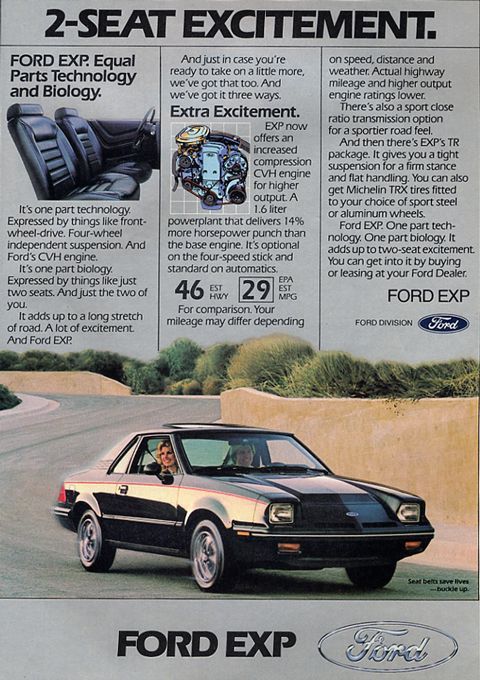
![Inserat für den Ford EXP im Jahr 1982]()
You can be so wrong
So much for the report by Automobil Revue's AR correspondent on the occasion of the launch of the Ford EXP and Mercury Lynx. Ford should have been able to sell millions of cars of the two models if the predictions had been correct. In fact, in seven years of production and despite model upgrades, more powerful engines and certainly a few marketing dollars, just 250,000 Ford and 40,000 Mercury cars were sold, although production of the latter was discontinued as early as 1983.
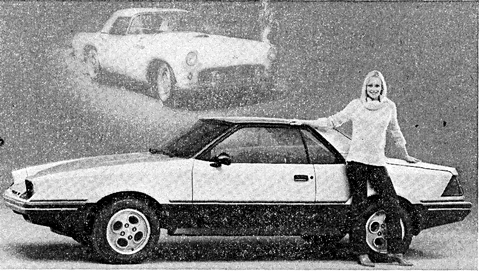
![Ford EXP vor Ford Thunderbird im Jahr 1981]()
Why did the EXP not become a hit? This is probably best explained by one of the press photos, which shows the EXP with a Ford Thunderbird in the background. The EXP's predecessors and role models were cars that made you dream. The home-made styling of the EXP could not achieve this. Especially as the car also lacked power and speed, even if people didn't seem to demand it. It is interesting to note, however, that even the car expert Behrendt could have imagined a success in 1981. Optimism can also be contagious ...