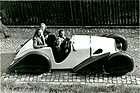
Dynamics in the still image


The impossible had to be made possible in order to show a car in its full driving dynamics. In the early days of photography, it was already difficult to take a static picture of a moving object. But for a long time, it was not even possible to show the whole thing in sharp focus in its dynamic environment.
Forced by the low film speed and the still low-light lenses at the time, the shutter speed had to be extended so much in bad weather that dynamic images had to be taken. Many of these were unusable, however, and only a few shots were printable. Most of them ended up in the trash.
One exception is the shot of the Hataz small car "Der Bergkönig" at the Pforzheim hill climb in 1923.

A so-called "pull-along" with a long shutter speed blurs the background. However, the vehicle should only move horizontally; additional vertical movement would lead to blurring. Pulling along creates wonderful pictures, provided the photographer has mastered his craft and can really move the camera at the exact speed of the vehicle.
The next level of dynamics comes when not only the photographed object moves, but also the photographer, for example in a vehicle in front, in order to take pictures of the vehicle behind. Of course, you don't want to "freeze" the whole thing, but show it dynamically, which calls for slower shutter speeds.
Suddenly you have to contend with several factors. The cars have to keep their distance, not move to the left or right, and the road has to be as flat as possible so that the cars don't bounce up or down, including the camera vehicle of course. The photographer must also keep the camera steady on the subject despite the driving effect of centrifugal forces in all directions.
As a special alternative to the so-called "car-to-car" image, so-called rigs were also used in some situations. Tripod arms that were screwed to the photo model. The remotely triggered camera moved along with the subject, and any visible "foreign objects" then had to be retouched out of the images.
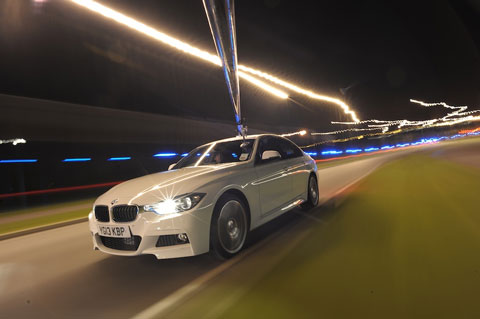
Now, with digitization, the big change. What used to take place with a great deal of effort, sometimes on closed-off streets, is now done quietly in the living room.
With today's image editing programs, pretty much anything can be done. You can photograph the car standing still and later realize the complete dynamics during image processing. Often the cars are not even in the environment shown, but are photographed in the studio and linked to the desired background on the computer.
In the past, faulty slides were thrown away and only the few successful shots were used. But even today, with all the computer technology, you are not immune to mistakes, as a picture in the current Motor Klassik issue 11/2016 with an overlooked "wrong click" (picture above, pay attention to the left front wheel from the driver's point of view) shows. When manipulating the car, part of the left front wheel on the Triumph GT6 shifted. But as the saying goes, where work is done, mistakes happen.
At this point, however, we must also give a big compliment to the Stuttgart team, because their magazine always impresses photographically. Keep up the good work guys!