This is also a classic car ...


Unbelievable but true, the solar vehicle pictured is now 31 years old. The solar racing car, built by Mercedes-Benz in collaboration with the small Swiss company Alpha Real, was launched at the Tour de Sol.
At that time, the journey went from Lake Constance to Lake Geneva. At the time, 58 vehicles with temporary road permits took part in the 368 km journey, which had to be completed in five daily stages without recharging from the power socket. And the professionally prepared solar car from Mercedes/Alpha Real crossed the finishing line as the winner, followed by the vehicles from the Technikum Biel and ETH Zurich.
The euphoria was great, as was the media response. However, the relatively low speeds of 20 to a maximum of 80 km/h and the low payload - even the pilot had to be as light and small as possible - dampened expectations of soon being able to replace gas-guzzlers with such vehicles. After all, renting the battery alone cost 20,000 francs at the time, and the solar panels - 4.3 square meters in the case of the Mercedes - added another 10,000 francs to the bill. And then there were the working hours ...
What is particularly interesting, however, is that Automobil Revue subsequently had the opportunity to test the Mercedes solar car and also measured its performance. The vehicle, which weighs around 180 kg, managed the sprint from 0 to 80 km/h in 47.5 seconds, and the top speed was measured at 80 km/h (average from two directions). The silver flounder completed the kilometer with a standing start in 59 seconds. The AR testers reported driving performance like a Citroën 2 CV from the 1950s, which had around 12 hp at the time. No wonder the car didn't run any faster, as the engine produced just 2.5 hp.
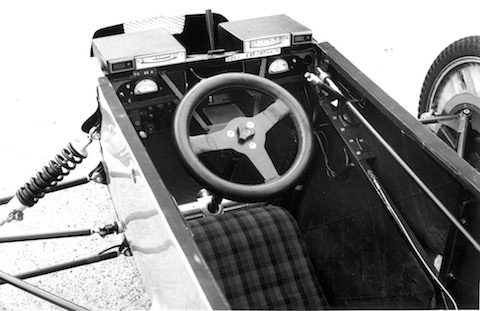
Driving was also much more demanding than one might have imagined. The engine could not cope well with currents over 40 amperes, so careful use of the accelerator pedal was required. At 50 km/h it had to be shifted a first time, at 60 km/h a second time.

Incidentally, the solar cells only provided the racer with a third of the energy it needed to reach 50 km/h, so even then it was not possible without batteries. It would certainly be interesting to see how much more efficient modern solar cells, batteries and electric motors are today if they were used with the same vehicle concept.
The entire report was published in AR 31/1985 . The photos can be found in the Zwischengas archive.