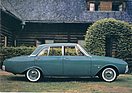
The tough job of car testers in the past - or - driving a Ferrari can be very demanding ...

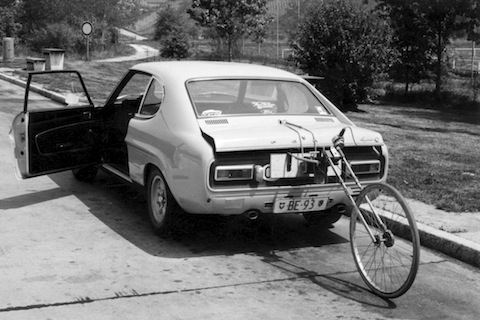
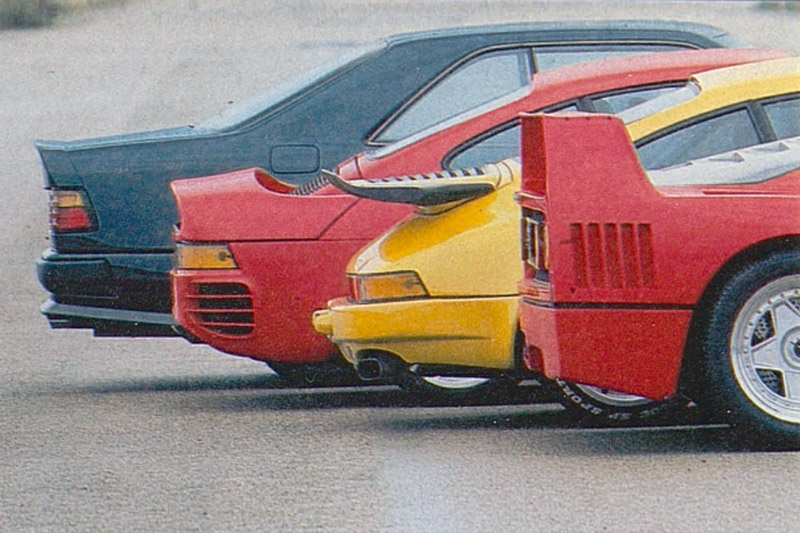
They are and were often envied, the car testers of the writing guild. Who wouldn't have wanted to drive a Ferrari 288 GTO or a Lamborghini Miura, but also a Ford Capril RS 2600or a Dino 246 GT when they were new cars?

But anyone who thinks these journalists had an easy life is mistaken. For example, achieving good performance test results was a tricky business. On the one hand, the valuable material was not allowed to suffer too much, on the other hand, good acceleration times required clutch-threatening starting maneuvers and the fastest possible shifting maneuvers. And of course the measurements were not taken once, but many times and in both directions.
And if the results were then too far from the manufacturer's specified performance values, the test driver's love was often withdrawn and the magazine was attacked directly by the factory.
A fast acceleration time in a modern car, on the other hand, is (usually) a piece of cake. Switch on the launch control and off you go, the rest is usually taken care of by the on-board computer, actuators and control mechanisms.
In the past, sensitivity and a lot of experience were required if the values read off the Peiseler wheel were to be convincing.
A good example is the test of the Ferrari 288 GTO from 1985/1986, which was documented in detail by Automobil Revue. We briefly summarized the procedure in our report, but the test actually required three complete test series on three different days. In between, the car had to be repeatedly repaired or readjusted, and on one occasion it even almost burned down. And despite all efforts, the 303 km/h top speed specified by the factory could not be achieved ...