From roadway, parking lot and vehicle widths

At the beginning of the 1980s, crossing an oncoming vehicle was hardly a problem, even when driving fast. But today, even when driving normally, you often have trouble avoiding a fleeting kiss from the wing mirrors or ruining the rim on the kerb.
A recent serious collision between a lorry and a Postbus has now stirred up discussions about the width of the carriageway. Suddenly, a large part of the Swiss road network should be widened and adapted to today's traffic. As in motor racing, vehicle development is given free rein and the race track or the roads are adapted to the ever faster or larger vehicles.
Let's do a little test. The width of a main road without bicycle lanes has long been a certain width of 3.25 meters. The Golf 1 is 1.61 m wide. Calculated on the road with a total width of 6.5 m, two Golf 1s took up a space of 3.22 m, leaving a free space of 3.28 m. With today's Golf Vll with a width of 1.8 m (measured without the exterior mirrors), there is 40 cm less space, i.e. the clearance is limited to 2.88 m. And that's with a Golf.
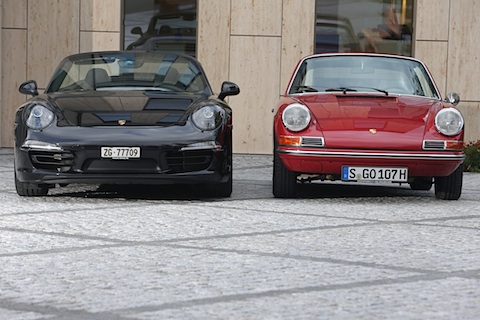
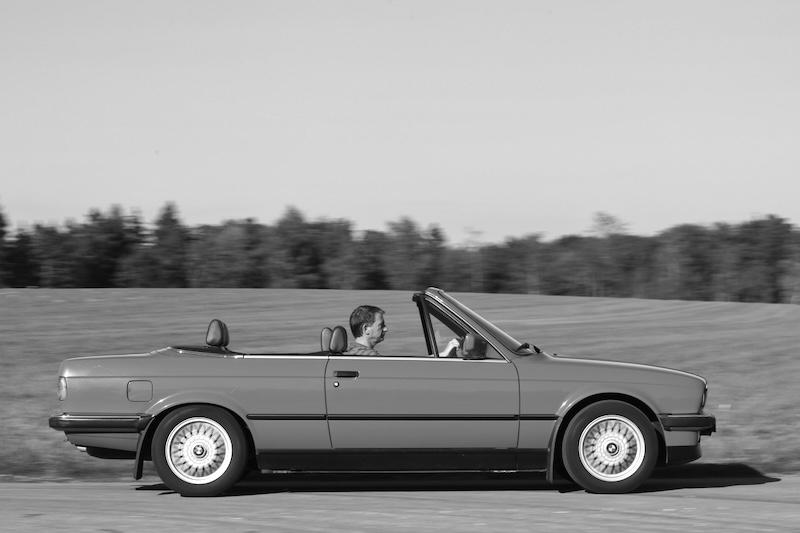
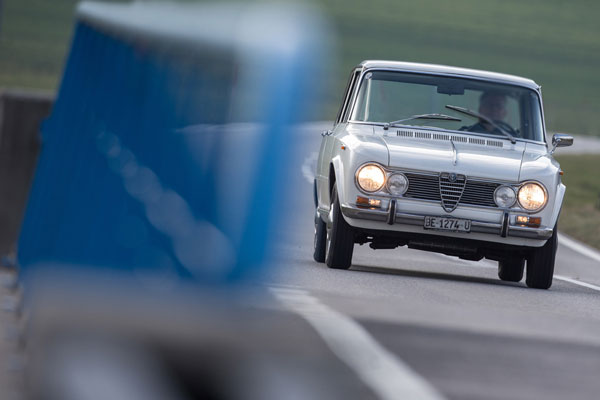
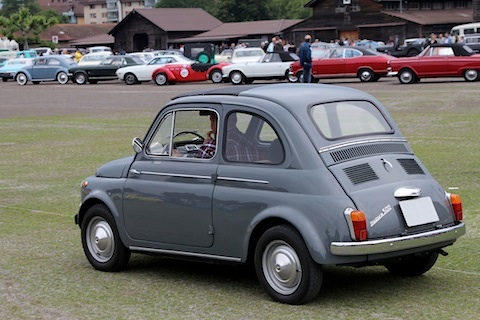
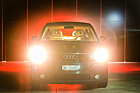
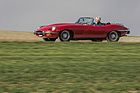
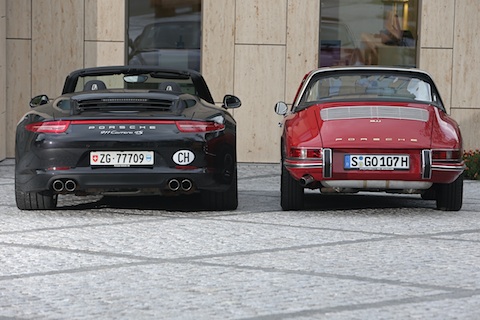
If we take the Porsche 911 (see pictures) or the Audi 100 C1 from 1970 with a width of 1.73 m, the clearance was already 20 cm less than that of the Golf 1. Today, the A6 C7 with a width of 1.87 m has a further 28 cm less, which means that only 2.4 m of clearance remains when calculated on the width of the road. If there is a bicycle in between, things get really tight. To be honest, all of us motorists have to admit that we are slowly reaching our own limits with the ever-increasing size of our vehicles. Despite the help of distance sensors or reversing cameras, you have to drive with millimeter precision in some multi-storey parking lots, or even outside parking spaces, in order to stay just clear of other cars, support pillars or house walls.
Parking is even more extreme than driving. Structurally limited to 2.35 - 2.50 x 5 m, there is hardly any space for the door to open for a reasonable entry and exit. Let's imagine three parking spaces of 2.35 m each between 2 support pillars. On the left-hand space is an Audi Q7 with a width of 1.98 m, on the right a Porsche Panamera with a width of 1.93 m. The space in the middle would be free, but with a BMW 5 Series at 1.86 m you wouldn't stand a chance. I can still drive the car just between the other two, but getting out of the car is no longer an option. The three cars take up 5.77m without mirrors, leaving exactly 1.28m free space for the doors with a total parking width of 7.05m. That sounds like enough space to get out, but do all the cars always park perfectly in the middle of the space? Hardly; and you already have a problem, or an annoying bump.
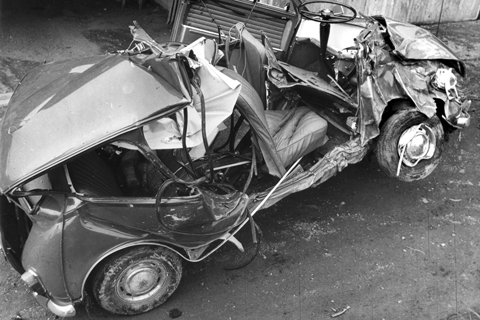
I really wonder why we need such large and ever larger cars. Safety is probably the main argument. OK, airbags and crumple zones have to be incorporated. But don't many accidents happen as a result of drivers deviating from the road without concentrating? Perhaps 40 cm more air between the vehicles could save more lives than the air in the built-in side airbag?