Contrary to preconceptions - automatic Opel Ascona successful at the Monte Carlo Rally

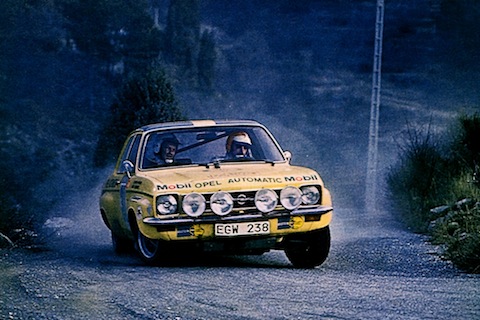
In the 1970s, only comfort-conscious people and those who simply wanted to have as little work as possible driving a car drove an automatic. The automatic was considered unsportsmanlike.
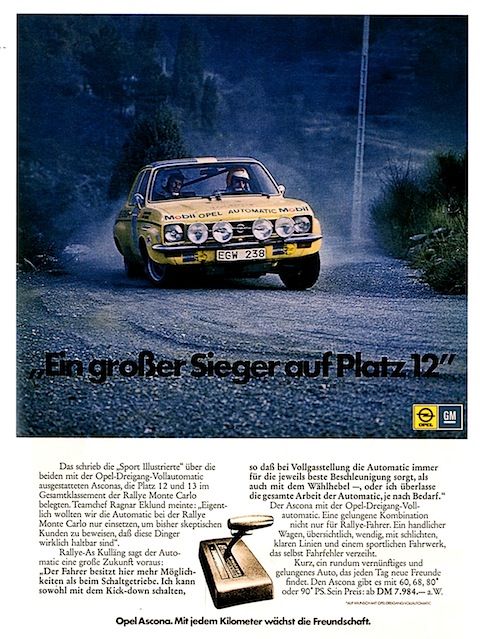
Opel, however, entered two Ascona SRs with automatic transmissions in the 1973 Monte Carlo Rally , not as a marketing gimmick, but because the cars had impressed in the test.
Of course, the success (12th and 13th place in the overall classification) was exploited for advertising purposes and the rally driver Kulläng was quoted as saying:
"The driver has more options here than with a manual gearbox. I can change gear with the kick-down, so that the automatic always provides the best acceleration at full throttle, as well as with the selector lever - or I can leave all the work to the automatic, as required ".
In its coverage of the 1973 Monte Carlo Rally, Automobil Revue also devoted a few sections to the automatic Opel vehicles, which provide a somewhat more detailed insight:
"Opel Sweden had some pretty hot irons in the fire: Lillebror Nasenius and Anders Kulläng, who each had a Group 2 Ascona 19 SR two-liter with automatic transmission from GM Strasbourg at their disposal for the first time. The automatic performed excellently: Nasenius and Kulläng finished 12th and 13th respectively. The performance of the "automatic" Opels was followed with particular interest, as it was the first time since the Chaparral days that the automatic had been used in a top competition with elite drivers. The tests carried out by Opel Sweden had proven that the automatic was better suited to winter rallies than the five-speed gearbox, even though the drivers had originally shown a certain aversion to the automatic.
The three Ascona 19 SRs carefully prepared by Opel Sweden had 170 hp engines with maximum output at 7500 rpm. The automatic transmission had been adjusted to the Group 2 engines at the factory, the three-speed gearbox shifted at 7000 rpm, while the maximum torque of 23 mkg was already delivered at 4200 rpm. The vehicles were geared for a top speed of only 130 km'h. In the course of the preparations (30,000 training kilometers), the automatic transmission was put through its paces and the drivers had to perform 200 to 300 race starts. With the car in gear and locked, the engine was revved up to 5000 rpm and then the brakes were released.
The transmission did not give way. During the first special stage at the Col du Corobin, Kulläng's brakes were defective, so the Swede simply engaged reverse gear before the bends ... The automatic held."
However, the automatic didn't really catch on in rallying after all ... at least not in the seventies ...