How many wheels does a car need?

The answer to the question of how many wheels an automobile needs is actually obvious. 99.99% (or more) of the cars on the road in the world - we are talking about passenger cars - have four wheels that maintain contact with the road. The Fiat Multipla is one example among thousands.

But the first automobile, the Benz Patent-Motorwagen of 1886, had only three, two at the rear and one at the front.

And in 1909, when H.F.S. Morgan built the first prototype of his Three Wheeler, he also decided that three wheels were enough. The only difference was that he positioned the single wheel at the rear, thus eliminating the need for a differential. He remained faithful to this design until 1953, because it drove well and outperformed most four-wheelers of the time.

The Messerschmitt Kabinen-Roller, the BMW Isetta, the Heinkel-Kabine and other three-wheelers of the 1950s also relied on the principle of two wheels at the front.

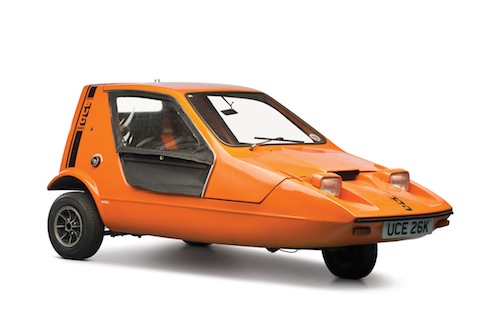
The British, however, thought differently and put the single wheel at the front of the Reliant Robin instead of the rear, with the result that many Robins tipped over. Nevertheless, they stuck with this design when building the Bond Bug (pictured above), but improved the road holding.
And the other extreme? Well, of course there are various cars with more than four wheels, a spectacular example of which is the sports car presented by the English company Panther in 1978. It was based on the Tyrell Formula 1 racing car, so it had four small steered wheels at the front. With around 600 hp, the car was supposed to be capable of 384 km/h and cost 250,000 Swiss francs. Of course, that wouldn't have been possible with three wheels ...

If you would like to know more about the three-wheeled Morgan, please refer to our new report on the Morgan Three Wheeler Super Sports from 1933 .