Trendsetter - reporting on pre-war exotics

The Automobil-Revue took an early interest in classic cars, long before the relevant magazines such as Motor Klassik or (Oldtimer) Markt came into being. As early as 1958, for example, the Turicum 5/16 PS from 1911 was tested (AR from August 13, 1958) and this tradition was later continued from time to time.
In 1970, a series of articles was initiated that presented famous pre-war vehicles. It began with the Cord 812.
Cord 812, 1937
(AR 17/1970)
With this article, the AR crew introduced the new series in April 1970 with the following words:
"With this and other short articles, we introduce "AR" readers interested in the history of the automobile to rare pre-war cars owned by Swiss people. It is a pleasing fact that more and more classic cars, especially from the 1920s and 1930s, have been restored or reintroduced in recent years.
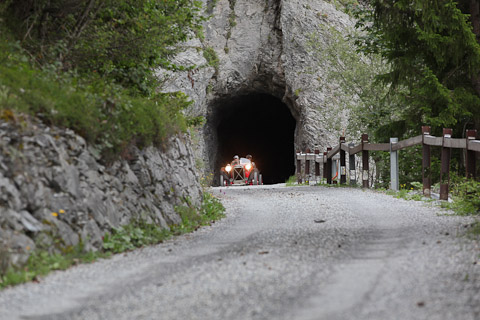
Most of the cars featured in our "Pre-war exotics" series took part in the 4th Autumn Meeting for classic cars in Weggis. This is an annual meeting that is organized entirely on a private basis. The initiator and driving force is the well-known classic car enthusiast O. Keller, Herrliberg."
Lagonda V12, 1937 (AR 21/1970)
Bugatti 57 SC, 1938
(AR 29/1970)
The AR staff wrote about the Bugatti 57 SC: "Bugatti Sport avec compresseur - Exclusive, distinctive, super-fast and therefore expensive automobiles are by no means an invention of the 1960s. What today is called the Lamborghini Miura, Ferrari 365 GTB/4, Maserati Ghibli or Monteverdi 450 SS hai was called the Bugatti Type 57 SC before the war. In total, only around 750 Type 57s were produced in the various versions, a small number of which were in the most powerful version. Comparisons with contemporary bodies of everyday brands show each Type 57 SC to be exclusive and sophisticated at first glance. With a top speed of around 200 km/h, it was one of the fastest sports cars. At over 30,000 pre-war francs, the proud price of such a vehicle with a special body was almost double the cost of the already quite exceptional Type 57 touring model." The original roadster body was designed by Englishman Eric Giles.
Lancia Astura, 1935 (AR 39/1970)
Little Marmon, 1927 (AR 8/1971)
Hispano-Suiza K6, 1937 (AR 24/1971)
BMW 327/8, 1938 (AR 40/1971)
British Daimler 25/85 HP, 1927 (AR 54/1971)
Packard Twelve 12 cylinder, 1933
(AR 9/1977)
The AR even provided a driving report on this vehicle, noting unusual and long-forgotten operating elements such as "Ride Control" (changes the hardness of the shock absorbers) or the rotary switch that influences the servo effect of the drum brake. The smooth and primarily quiet V-12 was praised and the rumble seat (grandmother's seat) was described as an airy travel pleasure.

Isotta-Fraschini Tipo 8A, 1928 (AR 35/1977)
Lagonda M45, 1934 (AR 46/1977)
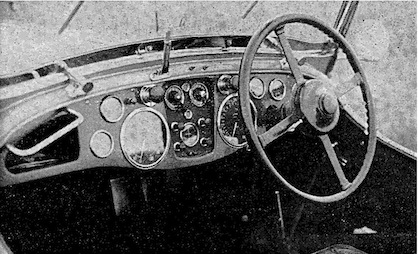
Mercedes-Benz 500 K, 1934/1948
(AR 41/1978)
Here, too, the AR was given the opportunity to try it out for itself:
"You are in very good hands in this aged luxury vehicle. The fact that you steer it with less outstretched arms than modern sports cars is readily accepted as soon as you negotiate the first bend in the road: By then at the latest, you are happy to be able to turn the steering wheel with bent arms. Due to the elongated, tapered hood, on which the elegant Mercedes star is emblazoned in the direct line of vision, it is initially difficult to correctly assess the vehicle's width requirements on a narrow road.
The Mercedes-Benz 500 K can and may be driven off in second gear without any problem. Its in-line eight-cylinder engine is pleasantly elastic, and the transmission, which is not yet synchronized in today's way, hardly needs to be shifted too often. The supercharger is activated via the accelerator pedal. However, the acceleration effect achieved at the required pressure point is by no means as fulminant and the roar is nowhere near as exciting as the "supercharger legend" Hesse expected.
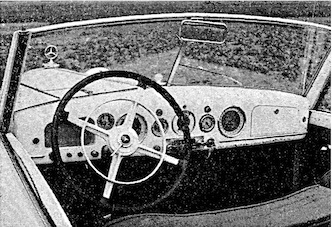
Maybach Zeppelin V12, 1931 (AR 17/1980)
The articles are worth reading and show the view of the 70s on the pre-war vehicle generation. The AR references here are all clickable and lead directly to the respective article.