Were supercars more superior to normal cars in the 1950s than they are today?

When I recently read the AR review of the 1951 Ferrari 212 Export, I couldn't believe my eyes. The authors apologized for almost losing their usual detachment and neutrality because the car was so incomparably good.
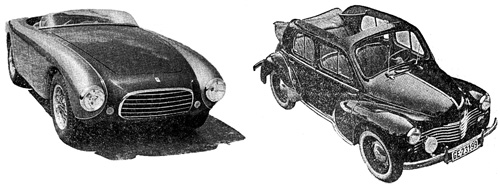
If you compare the driving performance measured with a "normal car" of the time, Renault Heck, then the acceleration times of the Ferrari are actually 3-5 times better and the top speed almost twice as fast as the Renault. But this is also true for today's entry-level VW Golf, if you compare it with a Lamborghini Gallardo LP 560-4. Interestingly, the price difference has also remained within a similar range (factor 6-10). Nevertheless, the difference between the aforementioned Golf, or a higher-value version of the VW Golf, such as the Golf R, no longer seems as far removed from the Gallardo as the Renault is from the Ferrari. In fact, with a little tuning, a Golf R can be optimized to such an extent that it achieves lap times on the Hockenheimring similar to those of the aforementioned Gallardo. This would certainly never have been possible with the Renault rear end, the differences in engine, chassis construction, suspension and weight distribution were too great. It must also be said that the extra power of the Gallardo can hardly be exploited in normal road traffic today, whereas the authors from the 1950s considered the better "climbing ability" and the "pulling power" in the longer gears to be a valuable asset. Interesting in this context, however, is the statement that "through roads in Europe, including highways, would not permit such high speeds (160-200 km/h) due to the relatively narrow width (!)".