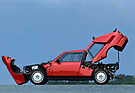
What's that chirping?


Alongside the five-cylinder snarling of the Audi Quattro, it is probably the sound of Group B: the short, dolphin-like chattering when Röhrl, Mouton or Blomqvist abruptly let off the gas before a bend. And at least as naturally as the last evolutionary stage of the Ingolstadt all-wheel drive monster is given the wrong name today , the unmistakable load change sound is attributed the wrong origin.
This is because the bypass valve, usually referred to as the chirping machine – also known as the "wastegate" – has nothing whatsoever to do with it. Rather, its task is to allow part of the exhaust gas flow directly into the exhaust pipe without going via the turbine, thereby limiting the boost pressure. As a result, it does not open when the throttle is released, but when it is applied – and then more with a farting noise.

Its counterpart on the intake side is the recirculation or blow-off valve, which directs the already compressed but unused ram air back in front of the compressor wheel when the load changes – and emits a whooshing sound in the process. However, this component is not absolutely necessary and is therefore not always present. So which valve has to open for the distinctive flutter sound to be heard? None! It is caused, metaphorically speaking, by the counterpart to the turbo lag.
When the throttle in a turbocharged engine is fully cut back, the compressor wheel – driven by the last of the exhaust gases still escaping – continues to turn for a brief moment. However, the compressed air can then no longer be drawn into the combustion chambers, but accumulates at the closed throttle valve. However, as the excess pressure still has to go somewhere, it goes back to where it came from: into the compressor, whose impeller is abruptly slowed down by the sudden oncoming traffic.

The friction of the air squeezing through between the compressor blades and housing causes a whistling noise. The pressure reduction allows the compressor wheel to rotate faster again for a brief moment, until the back pressure becomes too high again and the whole process is repeated until the rotational energy of the compressor wheel is completely dissipated – or the throttle valve opens again. This rapid alternation of pressure build-up and reduction ("pumping") produces the distinctive chirping, chirping, giggling, chattering or whatever you want to call it.
The higher the boost pressure, the stronger the effect. In this respect, the wastegate is not entirely uninvolved. However, as the volume of the pumping noise increases, so does the mechanical load on the turbocharger. In the yellow and white five-cylinder singing birds, the compressor was therefore put under quite a lot of strain. But that was all right. After all, it only had to endure one special stage at a time.