Classic cars are less economical than sometimes assumed (Question of the week)

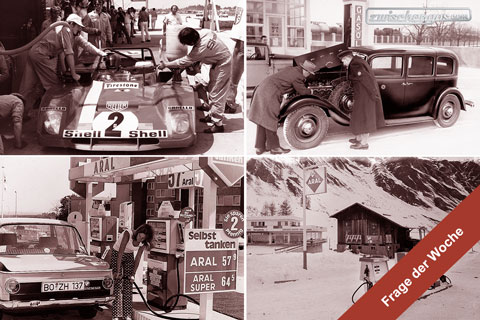
You can read time and again that cars used to consume significantly more gasoline than today's modern vehicles. Sometimes this is true, sometimes not. We wanted to find out more and asked a " question of the week " .
"How much petrol (or diesel) do you have to fill up your favorite classic car with per 100 km?", we asked our readers.
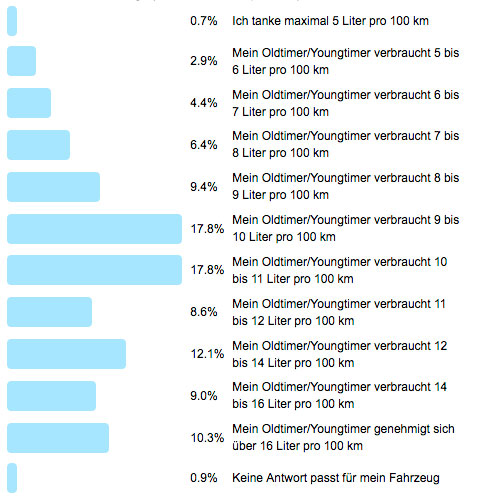
The result was somewhat different than we had expected. If you convert the more than 450 different answers into an average consumption, you end up with around 11 liters per 100 km. Of course, the mix of vintages and engine displacement is the main driver of the average consumption.
Specifically, 0.7 % stated that they need to top up with a maximum of five liters per 100 km. 2.9 % need 5 to 6 liters, 4.4 % 6 to 7 liters, 6.4 % 7 to 8 liters and 9.4 % 8 to 9 liters.
The majority of classic cars, however, consume 9 to 10 liters (17.8%) and 10 to 11 liters (17.8%) respectively.
8.6% fill up with 11 to 12 liters, 12 to 14 12.1%. 14 to 16 liters fill up 9%, over 16 liters per 100 km 10.3%.
It should be noted that consumption of over 10 liters was the norm in the fifties and sixties, unless it was a small car. Logically, even 50 years later, these cars cannot suddenly get by with seven or eight liters per 100 km.
Graphically, the results look like this:
However, we have already formulated another new question of the week . This time, we would like to know whether it is okay to install a later, more modern engine in the classic car.
And as before, all previous questions of the week, or rather their evaluations, can of course be viewed in a separate topic channel.