Who is faster? Audi RS7 versus Auto Union Type D - son versus father

Bruck and Fusch are towns on the northern side of the Alps, where the famous Grossglockner Alpine Road begins. It ends on the southern side of the Alps in Heiligenblut, in Carinthia, Austria. It is almost 50 km long.
As the story of the legendary hill climb and the great victory of Hans Stuck in 1938 with his Auto Union is of particular interest, it is mainly the northern part of the road that is discussed. Thanks to numerous archaeological finds, we now know that there was already a border pass here in ancient times.
In recent centuries, the area has lost its significance as an important transit route. The main traffic arteries have shifted to the neighboring Brenner and Tauern passes. While the idea of a tourist road dates back to the times of the monarchy, the Carinthian politician Franz Wallack set a different focus for the new road in 1924: as a result of the Treaty of St. Germain in 1919, Austria had to cede South Tyrol to Italy and thus also lost the Brenner Pass, so the revived idea of this road can also be attributed a political validity.
The mountain races undoubtedly also had political significance. The first was organized on 4 August 1935 and led over 19.5 km from Fusch to Fuscher Törl. The finish line was 2378 meters above sea level. It was the race with the greatest difference in altitude. There were 1593 meters of altitude to climb between the start and finish. In addition, every bend was at least eight meters wide and this special feature at the time made the route ideal for fast road races. The successes and enthusiasm over the road, which was not yet asphalted at the time, were so great that the race has remained forever in the memory of many.
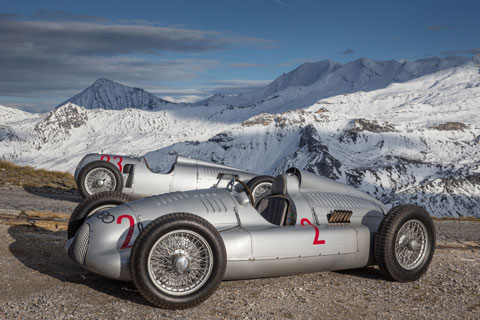
The second hill climb, now called the "Grosser Bergpreis von Deutschland" after the annexation of Austria, took place on August 28, 1938, exactly 80 years ago. Hans Stuck, the king of hill climbs, was naturally one of the favorites with his Auto Union. We searched the surrounding villages for locals who could still remember this race, initially without success. Finally, someone from the Bergstrasse administration sent us to Siegfried Scherrer, who was approaching his 90th birthday. "Just a moment, Mr. Scherrer is in the kitchen checking the food deliveries," the lady at the reception of the large and luxurious hotel directly on the main street in Fusch told us. Shortly afterwards, a lively man opened the door with the words: "Excuse me, but it's the summer season and we're really busy."
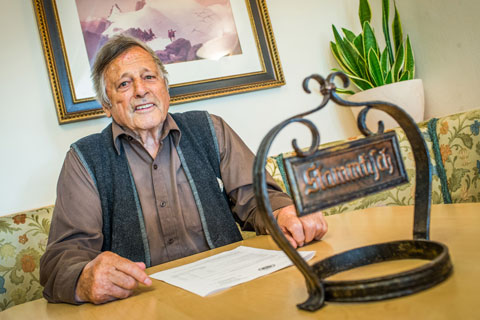
Siegfried Scherrer is still the head of the family hotel. "We used to have a house here and rented out a few rooms. My father had a store and maybe six simple guest beds. We also had a car, which my father used to drive people up the Grossglockner, as he had a cab license. But it was a poor area and the road was God's blessing for us."
Scherrer began to tell the story as if it had happened just a few days ago and not almost a century ago. "Jesus, back then nothing was like it is today. Every year in June, people started to clear the road of snow. A good 600 to 700 people were busy for around six weeks. Until Franz Walleck invented a snow clearing machine. It still stands today as a museum piece at one of the countless bends. It is blue and white, symbolizing the sky and snow. Of course, it was a great enrichment for us back then, really....."
Adventurous stories just bubbled out of him. When we asked him about Hans Stuck and the silver Auto Union, his eyes lit up and he exclaimed: "I have a very special story for you in this case! Of course, we children watched the race from the roadside. I was ten years old at the time. We were sitting on the grass, just three kilometers from the village. The Auto Union racing car came to a halt very close to us. Apparently something had broken. Hans Stuck was standing next to it, worried. We knew all the racing drivers, of course, because they had trained here before, including Caracciola, Nuvolari, von Brauchitsch, all the stars of the time..."
Three boys came up to him and marveled at the mighty, powerful racing car when Stuck asked them to please try to push it again, otherwise it would miss the start. After just a few meters, the car started and all we could see was Stuck's arm raised in thanks and greeting....
"Later, on his second drive," recalls Scherrer, "Stuck noticed us standing a little further up the road and waved to us again as he raced towards his victory. I will never forget that. With our help, we may have helped him to victory," the hotel owner concludes his memories with a laugh.
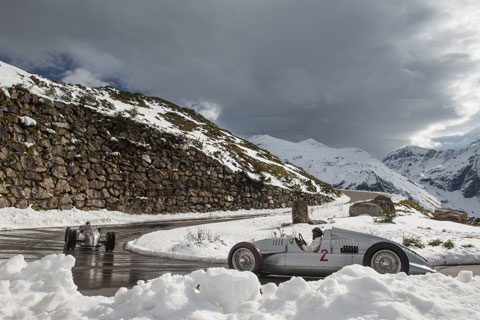
Many, many decades later, Hans Stuck's son, the now much better-known Hans-Joachim Stuck, tried to beat his father's time in a modern Audi RS7 Sportback:
In 1938, Hans Stuck needed 20 minutes and 10 seconds in his Union car for two runs on the 12.6 km track, which had been shortened due to bad weather, i.e. 10 minutes and 5 seconds per run. In other words, he raced up the mountain at an average speed of 74.7 km per hour. Even today, there are no special restrictions on this road; after all, it is a toll road for tourists, on which only the general Austrian speed limit of 100 km/h must be observed. For the test, the early morning hour was chosen when the road was still closed to visitors, i.e. before sunrise, which meant shortly before 6 a.m. The training runs were also carried out at these times in 1935, 38 and 39.
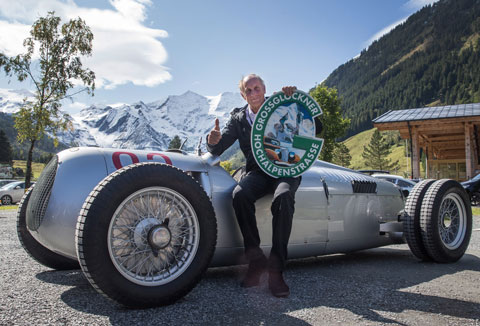
On the straights, the permitted top speed of 100 km/h could only be exceeded for a few seconds from time to time. As the Audi, like the Auto Union at the time, was alone on the track, the brakes were allowed to smoke, the tires to squeal and the exhaust system to roar... To be on the safe side, the limit was not quite reached, but Stuck Junior drove through the bends as quickly as possible. At the Fuscher Törl, the stopwatch in the RS7 showed exactly 9 minutes, 45 seconds and 9 tenths. His father's eighty-year-old best time was beaten.
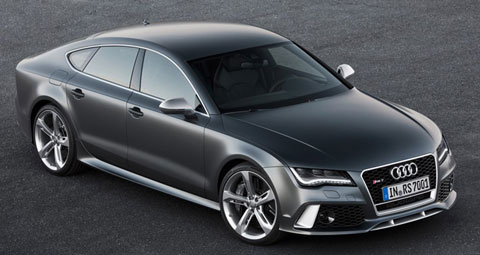
However, if you consider that in 1939, just one year after his legendary victory, Hans Stuck drove his Auto Union over the Grossglocknerstrasse, which was only partially secured with cobblestones, in less than nine minutes, then the RS7's time is put into perspective again ...