Back to the beginnings - the Porsche 356-001 in Bremgarten

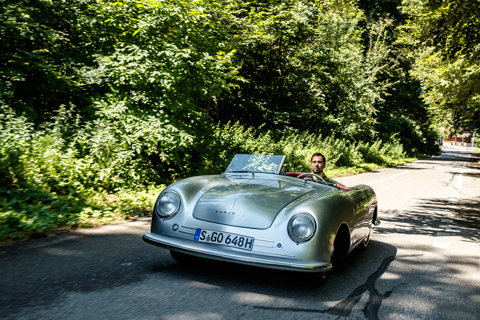
Much is being written these days about the origins of Porsche and the first sports car to be built and sold under this name.
"On June 8, 1948, Prototype No. 1 received general operating permission for Austria with an individual permit; the internal type designation was 'Sport 356/1'. On June 15, the vehicle was given the famous license plate number "K 45-286" and on July 4, the "Sport 356/1" was presented during the Bern Grand Prix in Switzerland, where it was tested by various journalists in advance. On July 7, the first driving report on a Porsche appeared in Automobil Revue under the title 'The latest offspring of a great name - Porsche 356, a new rear-engined sports car'," announced Porsche's Swiss press office proudly, and had Le Mans winner Neel Jani hop into the car and drive it in Bremgarten on a section of the Grand Prix circuit in Bremgarten near Bern, just as he did when the car was first presented. Neel Jani comments: "Back to the roots - I am delighted to be able to drive the number 1 on this former section of the track near the Eymatt. Especially as this is exactly where the first ever press test with a Porsche took place, which then appeared shortly afterwards in Automobil Revue."
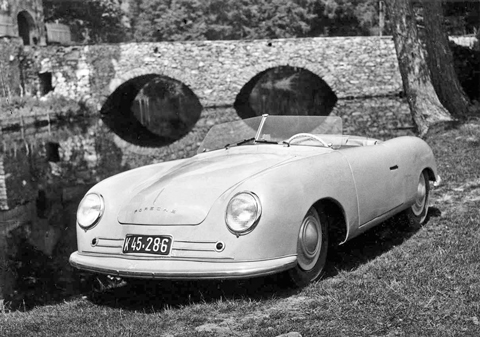
On zwischengas.com, the entire article as it appeared in Automobil Revue at the time is of course available in its original digital layout in the magazine archive , but it is reproduced here in full for interested readers as a text entitled "The latest offspring of a great name - Porsche 356, a new rear-engined sports car":
"Sometimes chance is kind to you. The detailed description of the Volkswagen in this issue had caused us a few stomach aches in that we anticipated that the contingent of sporty drivers would certainly immediately inquire about the possibilities of developing a fast vehicle from such a safe-to-drive Volkswagen. We have been receiving such inquiries periodically ever since people started talking about this car again, and we have been reluctant to draw out our enquirers with excuses. Today we can tell you why we advised against tinkering with the Volkswagen ourselves.
It won't be necessary for sports enthusiasts to get behind the wheel of the Volkswagen. The person who can do this best will ensure that such a vehicle is available in the near future, namely Professor Porsche himself. Recently, Porsche-Konstruktionen-GmbH, which is based in Gmünd (Carinthia), the British zone of Austria, and where Professor Porsche and his son are joined by many of his assistants, including Professor Robert Eberan von Eberhorst, who is well known to our readers, completed test drives with the prototype of a newly created sports car with the type designation 356 with such success that it was now possible to consider series production of this vehicle.
This car, which was derived from the Volkswagen, also drew on the wealth of experience gained by Porsche and its staff in building the Auto Union racing cars. With minor modifications, the engine, transmission and the suspensions of all four wheels corresponded to the solution used in the Volkswagen. The extremely torsionally rigid frame with lateral box beams and continuous arches was a fundamentally new development, as was the aerodynamically favorable body in the form of a two-seater coupé. This design was not a complete innovation for Porsche, as it had already developed a similar variant from the Volkswagen before the war.
The new car was initially only produced as a closed streamlined coupé. In addition to two very generously dimensioned seats, it had a large luggage compartment under the roof, which could also be converted into a seat for a third adult or two children. The body is not yet sufficiently developed to be captured here in the picture; however, we can already reveal that its low, elongated shape will meet with the approval of lovers of a sporty streamlined vehicle. It is handcrafted from sheet aluminum and forms an exceptionally rigid and torsionally stiff unit with the curved sheet steel box frame.
The design and arrangement of the engine drive block largely corresponds to the original Volkswagen engine. It has two Solex downdraft carburetors with a slightly larger intake manifold. The displacement is reduced by reducing the crankpin diameter and thus the stroke so that the car just fits into the class up to 1.1 liters, which will be important for sporting activities. The engine was not over-bred, but the braking power was increased from 26.5 hp at 3000 rpm to around 40 hp at 4000 rpm, which corresponds to an output of around 36.5 hp/liter.
From the appearance of the car and its ample interior dimensions, one would hardly guess that its dimensions were extremely modest. In fact, they are as follows: Wheelbase 210 cm, track width front 125 cm, rear 129 cm, length 387 cm, width 167 cm, overall height of the loaded streamlined coupé 126.5 cm. The exceptionally low center of gravity, together with the pendulum rear axle of the Volkswagen and the Porsche front axle with longitudinal rocker arms and torsion bars as well as hydraulic vibration dampers, gave the car good handling characteristics. To compensate for the rear engine and its influence on the position of the center of gravity, the spare wheel, the 50-liter fuel tank and the battery are housed under the front, hinged hood. The ground clearance of 20 cm is greater than that of much higher vehicles. Equipped with 5.00/16 tires, the car will weigh around 550 kg empty, which corresponds to a power-to-weight ratio of around 13.8 kg per horsepower. With a payload of two people, 30 kg of luggage and a full fuel tank, the corresponding figures are 770 kg, or 19.2 kg per horsepower. In this state, the weight distribution is 44% on the front axle and 56% on the rear axle. According to the factory, the machine should easily reach a top speed of 140 km/h and be able to negotiate the steepest Alpine roads with gradients of up to 30% in 2nd gear.
Short test with the prototype
Porsche has built a two-seater open-top sports car as a test vehicle, which the client for this model, Zurich-based R, von Senger, kindly made available to us for a short test drive last week. In the midst of the atmosphere of the approaching Grand Prix, we chased the machine around the Bremgarten circuit and quickly gained complete confidence in it. This is indeed the driving characteristics of a modern car that combines the advantages of modern suspension systems and their good ride comfort with the tenacious grip of an equally modern, low and manageable sports car. Although not yet fully in line with future production cars, the open two-seater, whose unusual shape understandably caused a stir everywhere, nevertheless showed that, thanks to its favorable power-to-weight ratio, it was an ideal vehicle not only for everyday use by sports drivers, but also for participation in sporting events. It should easily reach 40, 70 and 100 km/h in the gears and be able to cover longer journeys at 110 to 120 km/h in 4th gear, provided the roads are suitable. It is easy to handle and stable in tight bends, but also holds its course precisely on long, fast bends in the road. Bumps in the road make little impression on it.
These few lines may suffice as an initial foretaste. There is a good chance that we will soon be able to say more about the Porsche sports car, that the first vehicles will be delivered in a few months and that their price will be affordable."