Were racing drivers cowards and everyday drivers the brave ones?


We are looking back 50 years to a time when airbags, ABS and ESP, or similar safety features were still nowhere to be found in cars. Nevertheless, some car manufacturers had already committed themselves to improving passive safety, one of them being Volvo.
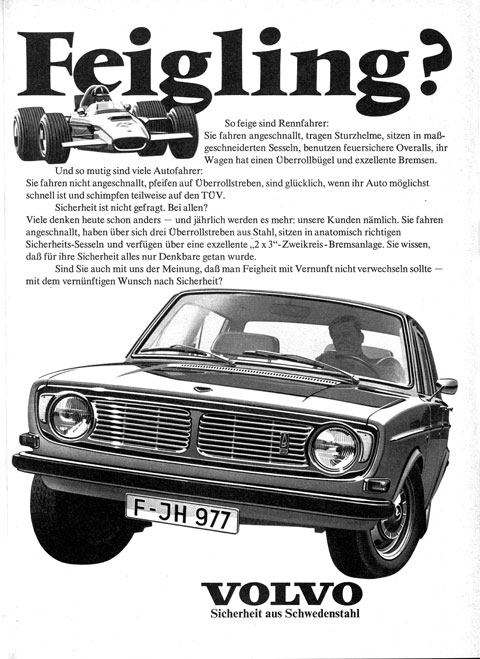
And apparently drivers had to be convinced of this first, which Volvo did with aggressive advertisements:
"This is how cowardly racing drivers are: they drive with their seatbelts fastened, wear crash helmets, sit in tailor-made armchairs, use fireproof overalls, their cars have a roll bar and excellent brakes.
And that's how brave many drivers are: they don't wear their seatbelts, don't care about roll bars, are happy if their car is as fast as possible and sometimes grumble at the TÜV."
In fact, the engineers from Sweden had built some things into the Volvo 144 that were not yet standard everywhere 50 years ago, namely crumple zones, integrated rollover struts, seat belts and a sophisticated braking system. And the advertising appealed to drivers' common sense: "Do you agree with us that cowardice should not be confused with common sense - with the sensible desire for safety?"
Today, everyday vehicles are much safer than racing cars in many respects, but the result is also significantly increased vehicle weights, confusing bodies and assistance systems that increasingly disempower the driver ...
Incidentally, Volvo did well with the safety approach back then, the 144 model sold very well and became the most successful Volvo to date ...