Why doesn't Lotus make it?

Colin Chapman founded Lotus Engineering in 1952 and built his first production car, the Mark VI, a kind of forerunner of the Lotus Seven, which is still being built today by various manufacturers, including Caterham and Donkervoort.
As early as 1956, Lotus celebrated class victories at Le Mans with the Type 11, while its major Formula 1 successes date back to 1963, 1965, 1968, 1970, 1972, 1973 and 1978, in each of which Team Lotus won the constructors' title, as well as a whole series of drivers' world championship titles.
In terms of production sports cars, the cars from Hethel impressed with their lightness and good driving characteristics, starting with the Lotus Elite, followed by the Lotus Elan, the mid-engined Europa, the wedge-shaped Elite, Eclat and Esprit models, through to the Elise and Exige, as well as the Evora, which are still being built today.
Production figures remained manageable and there were even memorable film and television appearances, for example with the Esprit S1 and S3 Turbo models for James Bond or the Lotus Elan for Emma Peel (the TV series "Mit Schirm Charme und Melone"). You could say that every child knows Lotus, there is no shortage of legendary material. Nor is there a lack of talented designers, as most Lotus sports cars are considered attractive cars.
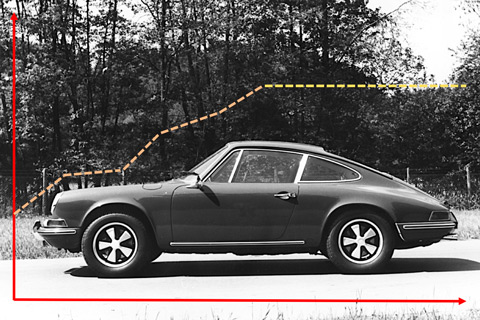
Nevertheless, the Lotus sports cars of the past have a much harder time increasing in value than their competitors from Italy or Germany at the time.
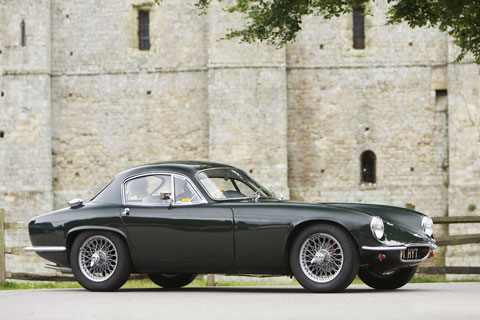
Although the Lotus Elite of the late fifties is one of the most beautiful cars of all time, prices at auction rarely rise into six-figure regions, with the exception of the particularly attractive Series 2 Super 95 Coupé from 1962, which Bonhams was able to sell a few days ago at the Goodwood Revival for EUR 122,306 or CHF 134,158.
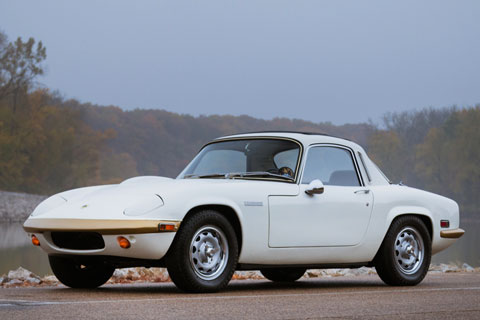
The Lotus Elan variants, whether convertible or coupé (pictured above), which have also become somewhat more expensive over the last ten years, are even more difficult to find, but are still quite reasonably priced compared to a Maserati 3500 GT, a Dino 246 GT, a Jaguar E-Type or a Fiat Dino Spider and are barely more than three times the original price at the time.
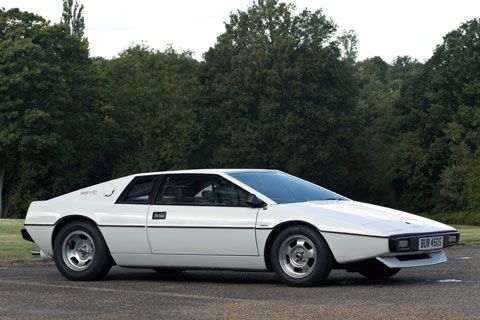
It gets even worse when you look at Europe or the Esprit. The prices asked there are usually still below the original price today, while competitors from Porsche or Ferrari from the seventies have been trading well above it for a long time.
What might be the reason for this? The fact that Lotus used plastic almost exclusively for the bodies? The Ferrari 308 GTB with a plastic body would make this relative. Or were the Lotus engines simply not sophisticated enough; only the Esprit was available with eight cylinders in the nineties, otherwise four cylinders were usually standard. Who knows.
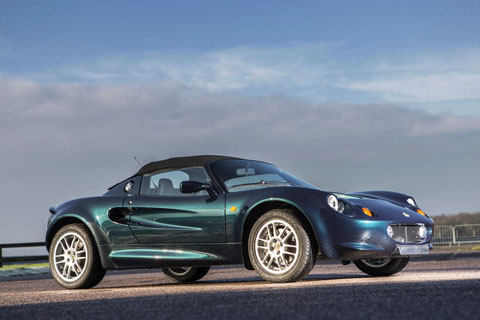
There is one ray of hope, however, and this is perhaps surprising. The Lotus sports cars of the modern era are worth significantly more than the competition in used condition and have also bottomed out earlier. You can rarely buy well-preserved versions of the Elise for less than EUR 16,000 or CHF 20,000, while the competitor from Zuffenhausen, the Porsche Boxster, is listed significantly lower than the lightweight sports car from Lotus, despite its higher new price.
Let's see what happens next. Perhaps the earlier Lotus models will also start to soar ...