Why a navigation device cannot replace a road map


Some people may wonder what the point of a paper road map is in the age of satellite-based navigation.
After all, it's so simple. When you're in the car, you enter all the details of your destination, more or less complicated, and you're guided to your destination by a friendly female voice.
Most of the time it works without a hitch, but every now and then the guidance goes wrong. Without a map and without local knowledge, people blindly trust the navigation system.
For example, when we were looking for our hotel in the Eifel during the Vintage Classic at the Nürburgring, we were guided to a residential area of detached houses. The navigation system got tangled up due to a road closure and so at eleven o'clock at night, three of us, each with a trailer and vintage car, drove two laps around the same four or five houses, while the announcement kept repeating: "Please turn left at the next junction, please turn left at the next junction" and so on, and so on. If we hadn't given up ourselves, we would probably still be doing our laps today.
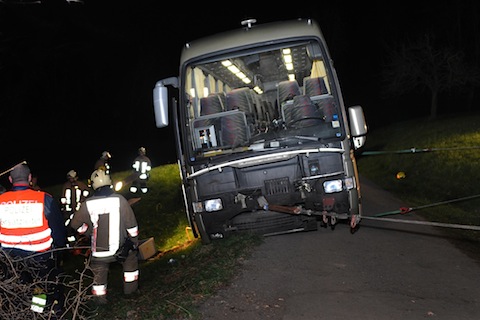
However, similar situations are worse when fully occupied coaches are misled by the navigation system. The bus pictured, secured by the fire department, was "guided to its destination via a shortcut" and became stranded while trying to negotiate a hairpin bend that was far too narrow.
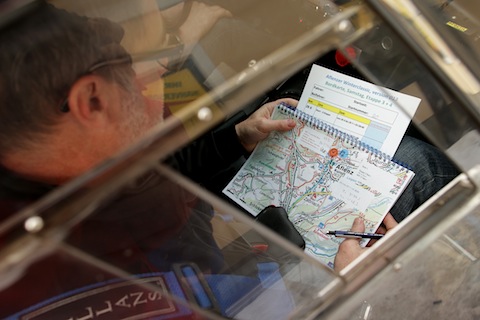
So let's get back to the good old paper road map, which not only expands the driver's spatial thinking, but can also be useful as sun protection in a convertible, for example when making a phone call (picture above).