When people began to measure the speed of automobiles ...
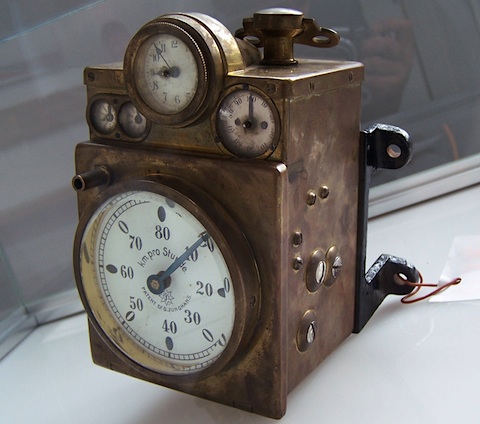
In the early days of motorization at the beginning of the century before last, the sense or nonsense of a speedometer was highly controversial. Around 1908, the Black Forest watch manufacturer Junghans therefore explained in detail in a brochure to hesitant car owners why motorists should purchase a "Junghans Apparatus - Registering Speedometer for Locomotives, Motorboats, Automobiles, Trams, Machines". The following sections are taken from this brochure:
"Why is a speedometer necessary?
Not so long ago, the automobile owner had to rely entirely on the information provided by the salesman and the driver as to the performance of his car, and even if both made their statements to the best of their knowledge and belief, the complete lack of suitable measuring instruments meant that serious deceptions were bound to occur from time to time. This has changed for the benefit of motoring since the advent of speedometers that are recognized as reliable by authentic sources. This gives the car owner a means of gaining a clear picture of the performance of his car and checking whether the driver has the machine in order. If this is the case, the car must always have the same gear on the same route under otherwise identical conditions. The registration of the speed completely excludes any observation errors, so that in this way a perfect judgment can be made about the actual performance, fuel consumption and fuel quality.
Further useful applications of the speedometer
The speedometer is directly indispensable for large touring races and competitions, etc. This is best demonstrated by the fact that speedometers were prescribed by the sports commission for the Prinz-Heinrich-Fahrt, the only important sporting event in Germany this year [1908?].
No sportsman will allow himself to be deprived of the opportunity to use his diagram to correctly assess his performance. In addition, these diagrams will always be kept as nice souvenirs of such sporting undertakings.
Recently, the racing cars of large companies have also been equipped with these devices, as the diagram actually provides the constructor with a reliable basis for the correct assessment of the performance achieved by his car.
The Junghans speedometer
is based on the principle of measuring the various rotational speeds of an automobile wheel, i.e. the speed of the automobile itself, against the uniform rotations of a clockwork wheel.
Some of the patents for the basic device date back as far as 7 years. All, even the smallest details, are original inventions and protected by patent.
The main advantages of this system lie in the fact that such an apparatus does not require empirical calibration, such as the apparatus built according to the centrifugal principle, and that the reliability of the measurement does not depend on changes in friction with regard to pin guidance, lubrication, wear and especially not on springs, whose elasticity is known to be subject to constant changes. "
According to research by the Junghans company, the illustrated timepiece dates from around 1905. The brochure was probably printed in 1908 due to the mention of "this year's Prinz-Heinrich-Fahrt". We found both in the Steim car collection in D-78713 Schramberg,