Currencies and exchange rates and their influence on classic car prices


We probably only notice it to a limited extent in everyday life , but currency parities change drastically over a longer period of time. As many classic car owners have invested part of their wealth in their vehicles, the question naturally arises as to what effect currency fluctuations have on classic car prices.
We need to look at three influencing factors in this context:
- How liquid is the market regionally and nationally?
- How great are any trade barriers and legal restrictions affecting the tradability of vehicles?
- How high is the price of a vehicle?
- How do the currencies develop against each other?
Let's take a closer look at these influencing factors. In the classic car environment, we are not talking about an arbitrarily globalized market. While some vehicle types really are traded in large quantities in all relevant markets, for example an MG A or a Mercedes-Benz 300 SL W198, other vehicles are only sold in very limited quantities and typically only in a few markets, for example a Glaspar G2 (USA) or a Ferrari 208 GTB (Italy). Only locally available vehicles will hardly change in price, from the perspective of the local market participant, if currency parities shift. Globally available vehicles, however, would have to become cheaper or more expensive according to the logic of supply and demand, depending on how currencies shift against each other.
The tradability of vehicles depends not least on how easy it is to move the object of purchase from one country to another. For example, local noise and emissions legislation makes it difficult to import vehicles built in 1982 or later into Switzerland, whereas vehicles built before 1960 should not normally pose a problem. At some point, many countries decided to go it alone in terms of legislation - just think of the crash and bumper standards in the USA, which disfigured cars in the 1970s and later. However, if vehicles were not sold globally in identical designs and local restrictions were in place, global/non-regional consistency would be restricted. Another barrier to trade can be the lack of availability of workshop knowledge and infrastructure .
When a vehicle is moved from one country to another, and therefore from one currency region to another, a number of costs are incurred: Transportation costs, insurance, customs, taxes, handling costs, adaptation to local legislation, etc.. As an interesting example, it is possible to register a vehicle for use on the road in Germany or the USA without a handbrake, whereas a handbrake is mandatory in Switzerland. Some of these additional transaction costs are (almost) fixed, so transporting a vehicle from the USA to Europe in a container always costs around USD 2,500 to 6,000, regardless of its value. Insurance and taxes, on the other hand, depend on the value. It can be deduced from this that very cheap vehicles are less attractive for large shifts, as the fixed components are then particularly significant. Around 10 to 20% of the value can be incurred as costs when exporting/importing, and the non-value-dependent portions alone can quickly amount to over 5,000 euros or francs, meaning that differences in value due to currency fluctuations must be considerable in order to leave the country.
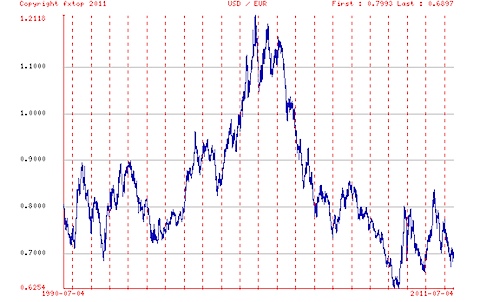
Currencies have shifted against each other more than we realize on a daily basis. For example, if 1 British pound cost around 1.7 euros around 2000, the value today is around 1.1 euros. Around 2000, 1 USD cost around 1.80 francs, today you can exchange for 0.85 francs. And even if we look at shorter periods, we see shifts of 30 and 40%. This cannot remain without an impact on prices.
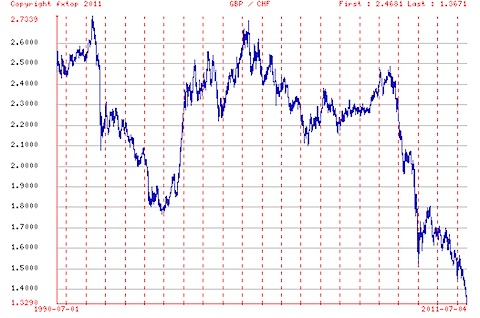
The effects of the influences discussed above can now be described from different perspectives. As a German or a Swiss, it has become cheaper for the buyer to purchase a car in the USA or in England. At the same time, however, the vehicle that a collector already owns has presumably fallen in value overall because buyers from the UK or the USA would pay less in the relevant local currency. Of course, these differences will only become apparent when the car is actually bought or sold. And many owners will then simply decide not to part with the vehicle if nobody wants to pay the asking price (typically in local currency).
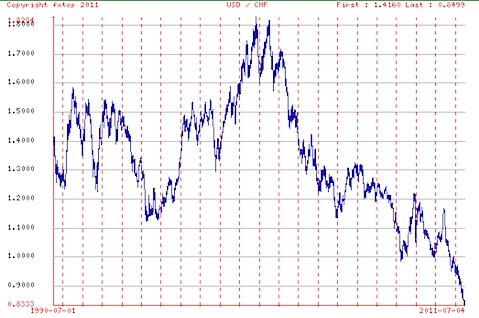
The enormous appreciation of the Swiss franc against almost all other currencies over the last few years has only had a limited impact on the market as a whole, because the volume of vehicles traded is not very large due to the size of Switzerland, but vehicle owners in Switzerland will feel the disadvantages especially if they want to sell a car internationally. On the other hand, the Swiss can currently buy classic cars cheaply on the world market, which can of course also have an effect on the local market, as "cheap" MG A or Porsche 356s, for example, are then sold.
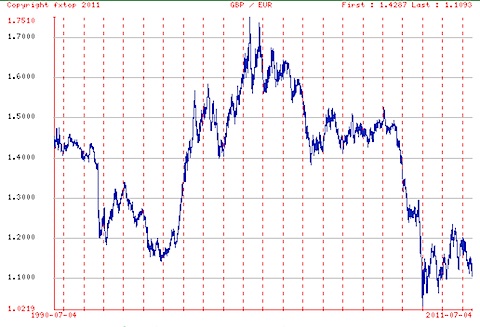
Note: The charts read as follows: For one unit of currency 1 (e.g. GBP, for pounds sterling), you pay in currency 2 (e.g. EUR, for euros) the amount shown on the vertical axis. The horizontal axis represents the time, starting with 1990 and ending with 2011.