The famous abbreviation

It's tempting to equip a car with a 6-volt system with an 8-volt battery and adjust the regulator accordingly. In theory this works, in practice - possibly. There is certainly no need to change any components at 8 volts, especially if the required voltage has not (or no longer?) been applied to the consumers for a long time. So instead of all the work with connectors, cables and switches, it would be tempting to simply install a more powerful battery, right?
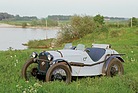
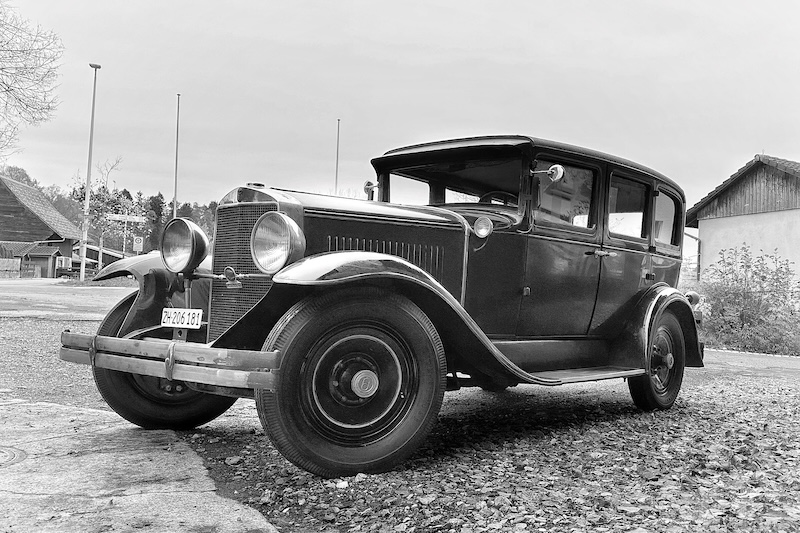
Well, my experience with shortcuts - the 8-volt solution would be one - is unfortunately not very good. Because critics of this idea rightly complain that an intact 6-volt system is perfectly capable of doing its job, just with the compromises you have to make with a classic. An 8-volt battery would only conceal the fundamental problems of the electrical system - reason vs wishful thinking. However, it would have been too nice, for example in the VW T1. I would never touch the Graham-Page (picture) anyway. But it has to serve as another example.
Because another super-simple solution seemed to be to replace the 6-volt soffits in the indicators of my Graham-Paige 619 with modern LED indicators. The idea behind this was to extend a blinker at the same time instead of just a red light when the indicators were swung out. This without having to install the corresponding wiring with relays, as the 96-year-old car is to be preserved in its original, unrestored state. I don't even know whether I could install a separate circuit for the light in the Scintilla indicators or whether everything is somehow connected. And swinging indicators are out of the question for me, they were never built for that purpose. But simply a lamp that flashes constantly on its own seemed ideal to me.
However, the salesman from Cagero, a VW parts dealer, warned me that the LED things require a minimum of 5 volts, otherwise they won't flash! They have their origins in the conversion of VW indicators to a system that can be more easily interpreted by modern motorists in today's traffic. That's right, something has to flash, otherwise it will be overlooked.
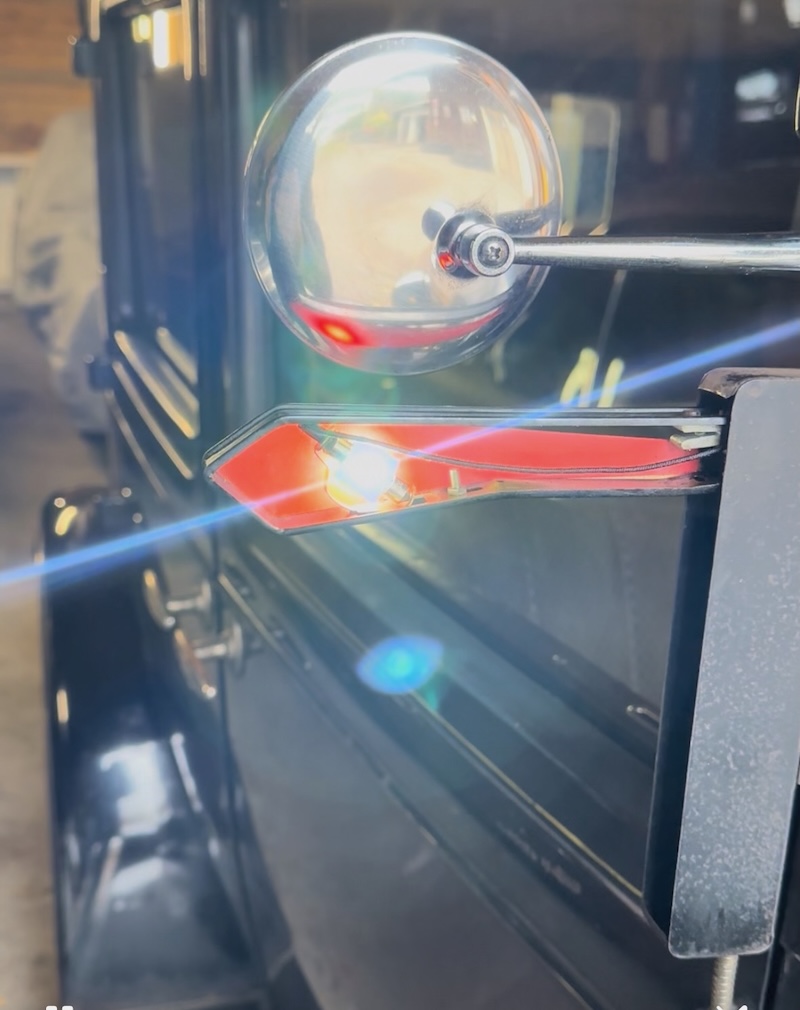
And lo and behold, it worked, quite well in fact! The only problem is the not very transparent red inserts of the indicators, which swallow up a lot of light during the day and - ultimately the killer - the fact that the indicators run out of juice when the two front lights, the position lights on the torpedo and the lone rear light at the rear are fully illuminated. Then nothing flashes! Unfortunately, this also remains the case when the alternator is supplying direct current while driving. So even at night, when it would be more visible, the expectations are not met. So back to field "A".
Now I'm thinking of a kind of add-on indicator system whose lights are simply attached to the bumpers and connected with pre-laid cables. These lead to a small box with a switch and an integrated electronic relay, which is hooked under the dashboard and connected to the vehicle electrical system via a hidden plug. Perhaps this solution, concocted in a flash of inspiration, will then work.