Clamping instead of screwing

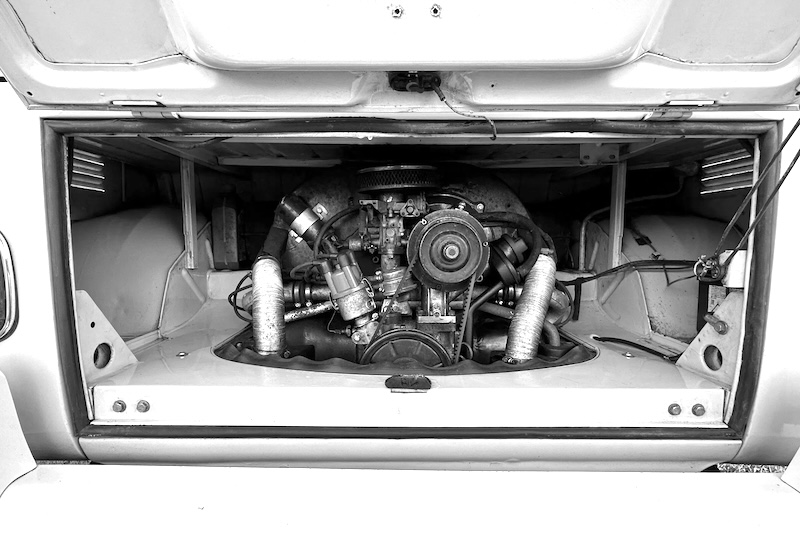
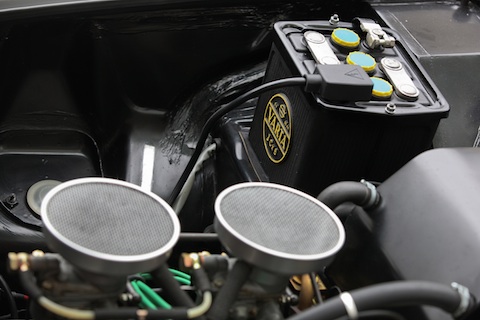
It's actually a relief, but on the other hand it's a nuisance. We are talking about batteries that are secured in the car with a strap. This is the case with air-cooled Volkswagens. The T1 requires an 84 Ah battery, ideally one with a hard rubber casing, of course. The point is, however, that in the bus the power storage unit is hidden in the right-hand corner of the engine compartment. For this reason, the purchase of a rather expensive battery according to the original specifications seems unnecessary to me. You never really see it there. In addition, the block is infinitely difficult to maneuver around the corner. Traces of leaking battery acid from the distant past prove that the mechanics of the Swiss army, who owned my car from 1965 to 1991, must have had a hard time with it - the picture is not of my bus.
I use a 50 Ah gel battery from a well-known brand with a red battery top. However, this is not suitable for a tensioning strap, which not only counts on the height of a rubber-cased battery, but also needs the cover on it so that the strap can be tensioned. The cover sits under the battery and the strap is underlaid with a thick, non-conductive PU block. Yes, it's a tinkering, but it keeps the battery securely in place and is also less sensitive to a short circuit than if a metal cover with a small gap covers the two battery terminals. All well and good...
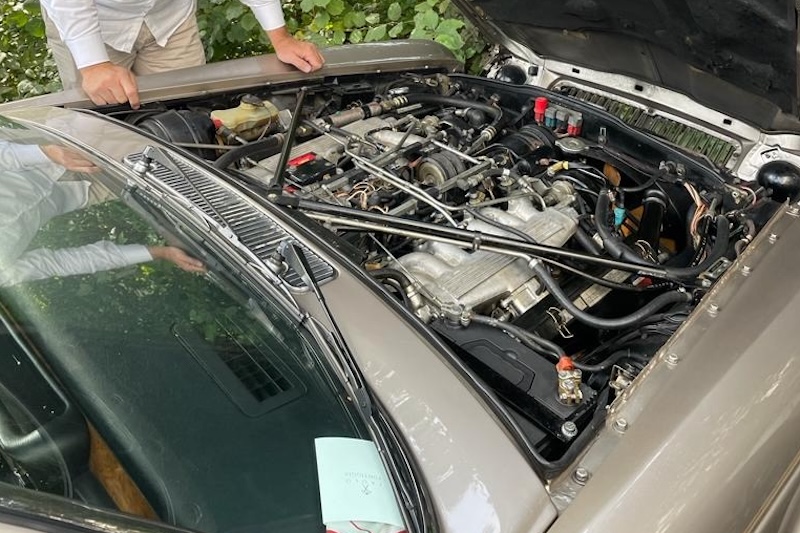
It was the diagonal braces, not the battery in the right-hand corner, that rumbled in the Jaguar engine compartment
On the Jaguar XJ, the battery sits directly on the right-hand side in front of the bulkhead, a finger's width below the corner of the hood. The correct format is crucial; if it were too high, the hood would no longer close. The ingenious economy of space is due to the gigantic V12 engine, which leaves little room for maneuver.
The battery is secured with a clamping bridge, which is screwed onto the battery plate with threaded rods and corresponding screws. The battery is thus "pincered". For a long time, I was annoyed by an annoying rumbling noise coming from the fuel wall, an excellent resonance box. The noises did not match the silky smooth running of the V12, so I went on an investigative search for the fault. I found one in the battery, which was perhaps not screwed down tight enough. So I tightened the screws a little more.
However, a former Jaguar mechanic located the fault by remote diagnosis and correctly identified the single screw with which the typical engine compartment diagonal braces of the XJ are screwed to the bulkhead. It was loose.
Now, with spring approaching, I visited my winterized Jaguar again and was shocked to discover that the tension on my battery case had caused it to sink in. The battery is dead, killed by the insensitive hand of an annoyed car owner who wrongly suspected it of causing noise. I would have liked a tensioning strap, but you can't have everything.