Why not register classic cars according to manufacturer country regulations? (Question of the week)


In the USA, imported cars that are more than 25 years old can be registered in accordance with the manufacturer's national regulations. There is therefore no need for (unnecessary) modifications just to bring a car into line with former registration regulations, which is often expensive and leads to a loss of original substance.
This is why US car buyers today can easily put a BMW M1 or Ferrari 308 GTB (without the US bumpers) on the road. This is actually reasonable, especially as such cars only make up a small percentage of the traffic volume.
Other countries have similar regulations, but in this country our regulations of the time also apply to cars imported today. That is why sometimes classic cars cannot be registered here at all or only after extremely expensive conversions and complex individual approvals.
Wouldn't it be better if we had similar rules to those in the USA and a car could be put on the road in accordance with the regulations of the country of manufacture at the time? This is exactly what we wanted to know from Zwischengas readers in a "question of the month " : Simplified registration of classic cars according to country of manufacture regulations?
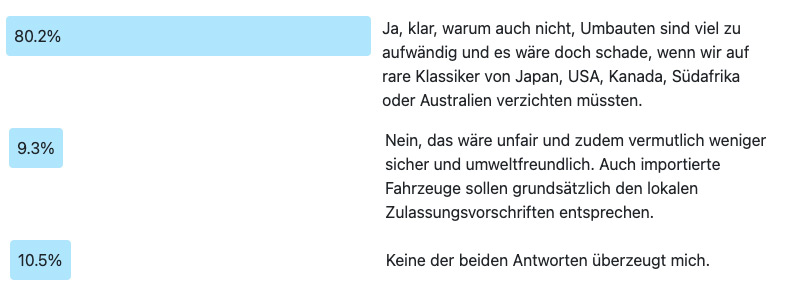
The tenor of the more than 200 responses was clear: 80.2% would be in favor of such simplified approval.
However, there were also 9.3% who felt this would be unfair and had doubts about safety and environmental friendliness.
And a relatively large proportion of 10.5% were not convinced by any of the answers given, perhaps because a more differentiated approach would be necessary or because it would depend on the era.
This is the result of the survey in graphic form:
And of course we have already asked the next "Question of the Month " . This time, we want to know whether the Zwischengas readers use their classic(s) exclusively or very frequently as an everyday car. We are curious!
Of course, you can still read all previous "Questions of the week and month " and their results in the corresponding topic channel.