A head start through low-tech?

Procon-Ten. A product name like that would have no chance of getting out of a marketing meeting alive these days.
"Programmed Contraction and Tension" was the full name for a system designed to increase passive safety in the event of a frontal collision. As dry and "ingenious" as this neologism appears, its origins can easily be traced back to Ingolstadt.
In the 1980s, Audiwas on its way to becoming a premium manufacturer and was strongly driven by engineering - literally. The management style of the then Chief Technical Officer Ferdinand Piëch is said to have once been described by Road & Track as "very one-two, one-two".
Piëch was never a man of many words. What has come down to us from him is all the more pointed. He made his antipathy towards airbags, which were not yet ready for series production, clear by saying that he did not appreciate having an explosive charge aimed at his face.
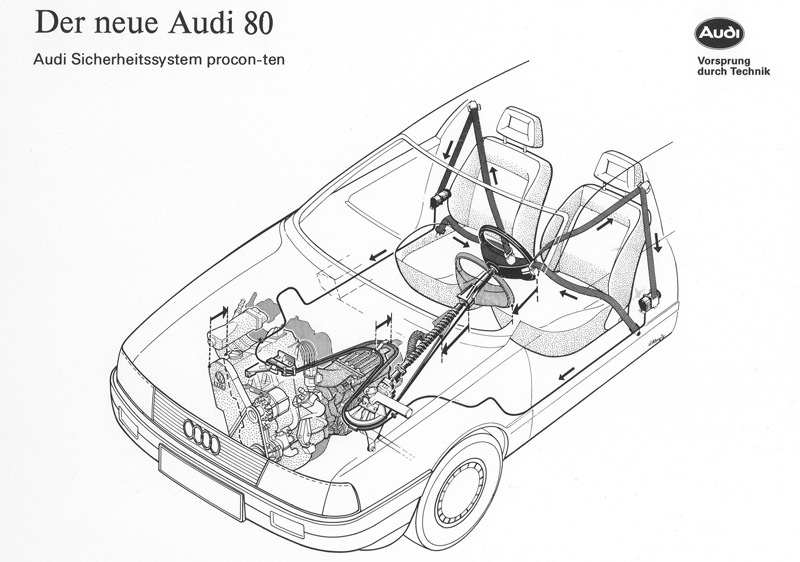
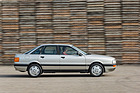
The alternative to the airbag, which Audi launched at the end of the 1980s as Procon-Ten, initially in the Audi 80 and Audi 100, was free of pyrotechnics and comparatively simple in design. The system worked with steel cables that were attached to the engine block, pedals, steering column and seat belts. In the event of a frontal impact, the engine block is displaced towards the passenger compartment. This relative movement causes the steel cables to pull the pedals and steering wheel away from the driver and tighten the seat belts.
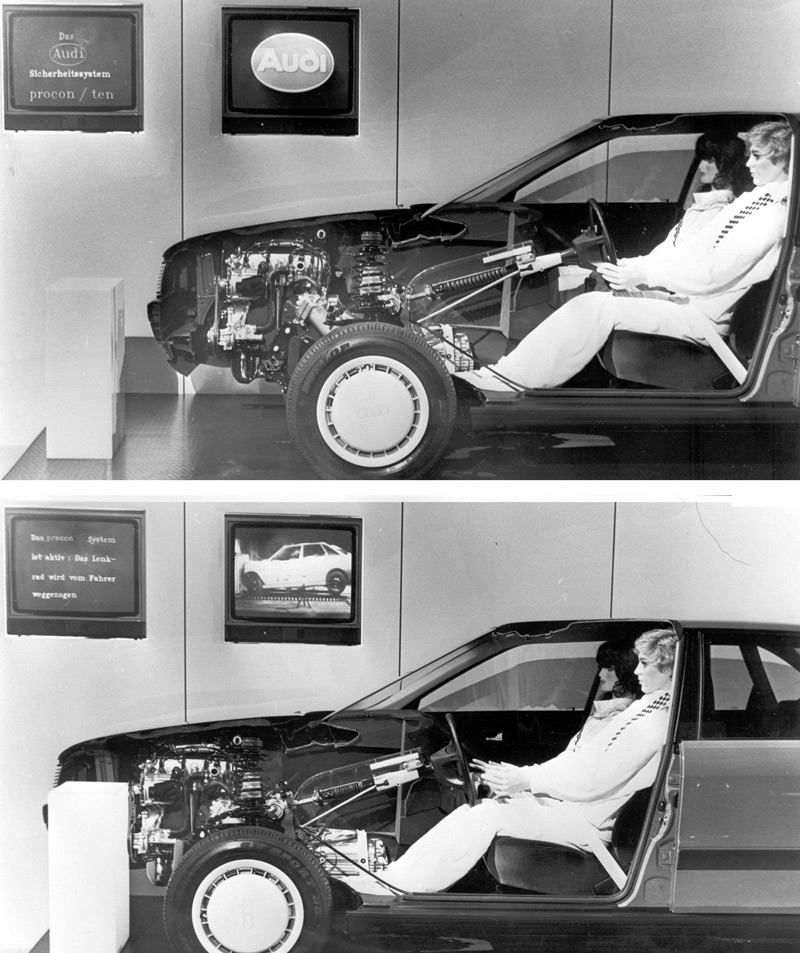
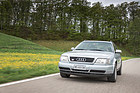
In a large-scale crash test conducted by auto motor und sport in 1990, the system worked quite well. Nine upper mid-range vehicles were crashed into a concrete block at 55 km/h. None of the vehicles were fitted with an airbag. In a real accident, some of the candidates would have suffered serious, probably even fatal, injuries. The Audi 100 (C4) was one of the best performers, thanks to its solid body structure and Procon-Ten.
Nevertheless, it did not come out on top. Whether this was due to the brittle name or the fact that a safety feature that was as invisible as it was in need of explanation generally sold poorly is hard to say. It can't have been because of the ingenious Audi video with the paper clip and the matchbox.
There is no doubt that the aforementioned crash test sensitized car manufacturers and the public to the issue of passive safety and was one of the triggers for making airbags standard equipment within a few years, despite Mr Piëch's reservations. Procon-Ten was finally a thing of the past and is now just an interesting side note in the development of passive safety in automotive engineering.