Interview with Oskar

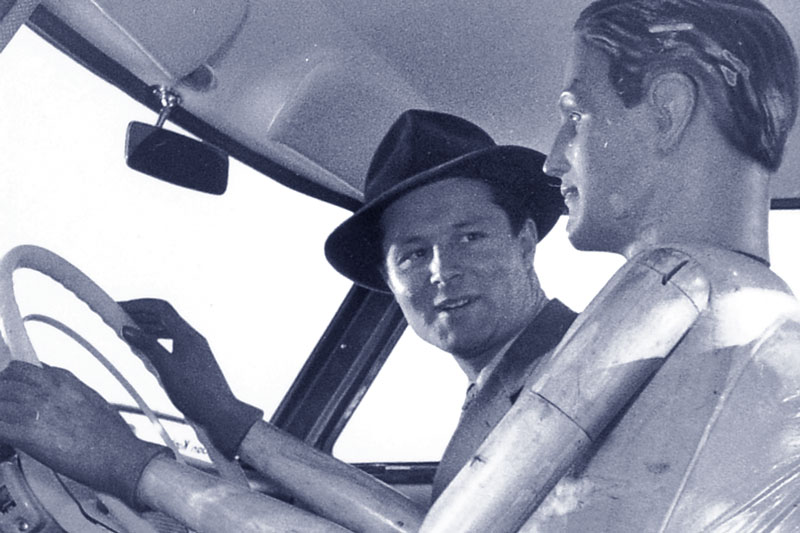
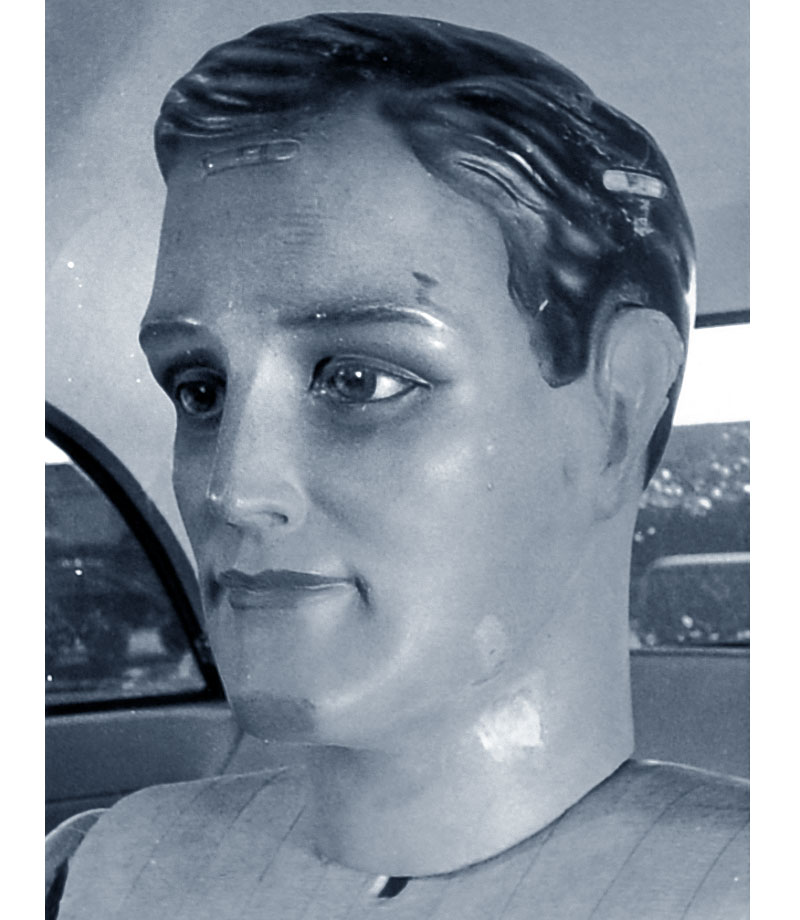
During our research, we came across an "interview" conducted by the Ford press service in 1958 with "Oskar", the wooden normal man who helped to develop body-compatible car seats. We found this "conversation" so interesting that we don't want to withhold it from our readers:
"Among the employees at the Ford plant in Cologne, Oskar is definitely the one who causes the least grief for the personnel office, the works council and the social department® Oskar makes no demands, because he is made of wood. Nevertheless, he has rendered outstanding services to the well-being of car drivers® If you sit better in the new Taunus 17 M than in older cars, it is not least thanks to Oskar's efforts.
We met Oskar in a side wing of the development department, where engineers and upholsterers work to create the most comfortable contact between people and cars. Our acquaintance with Oskar had to be made in installments, of course, because he had not yet concentrated when we arrived = head, torso and limbs were presented to us individually® Yes, things became even more complicated when it turned out that Oskar was the only Ford employee to have several heads, several upper and lower bodies, upper and lower legs® It didn't take long, however, and Oskar was sitting opposite us in his best shape, namely in his normal form: a 150-pound, 1 meter 75 tall gentleman with an attractive appearance.
The only remarkable thing about my ancestry - Oskar began to explain - is the fact that I wasn't born, but rather was determined. My mother is the statistic. Apart from that, I'm normal, very normal in fact, much more normal than anyone else.
I am the quintessential normal person. I am the average of hundreds of thousands of people who have been examined, measured and weighed because of me. I am the ideal car occupant who comes closest to all other car occupants - in terms of height, weight and posture. And to complete the measure of my charity, I am also interchangeable in all my parts. I can be longer at the top and shorter at the bottom and vice versa, in short, I can please everyone as long as they are within the norm and are not giants or dwarfs, featherweights or heavyweights.
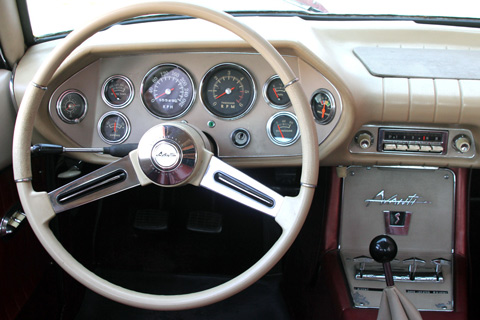
It is - and now Oskar's engineering manager joins in the conversation - a particular regret of the automotive industry that it cannot design car interiors, seats and their position in relation to the controls to suit everyone. We can accommodate different needs by adjusting the seats and backrests, but we are still bound by a standard when it comes to the basic layout. So what should this standard be? Each individual customer naturally considers himself to be the standard. Since we can't adapt to everyone, we must at least try to adapt to as many as possible. And this majority, this ideal approximation - that is Oskar.
He cost a pretty penny, but he's worth it because he's downright priceless.
Oskar is heaved onto an experimental set-up with combined forces. This is a car seat in a measuring device. Threads run from the surfaces of the seat and backrest over hollows and in front of a measuring sheet on which the deformation of the upholstery is now visible.
You can see the curves that Oskar presses into the seat and backrest. The ideal seat curves have been determined in countless series of tests, on the stand and in the moving car on mixed routes, with Oskar and also with living persons. Oskar's vibration amplitudes were recorded by instruments, and the ride feel of his warm-blooded companions was tested just as meticulously. In this way, it was possible to find out how and where to sink into the upholstery and how the seat shape had to be designed accordingly. When a new seat is developed, a new spring core or a new support is tested, there is no need to repeat all the tests. The ideal seat curve is known, and Oskar reveals in the test set-up how and where the seat shapes need to be modified, the springs reinforced, the supports changed so that the ideal seat curve is achieved or maintained.
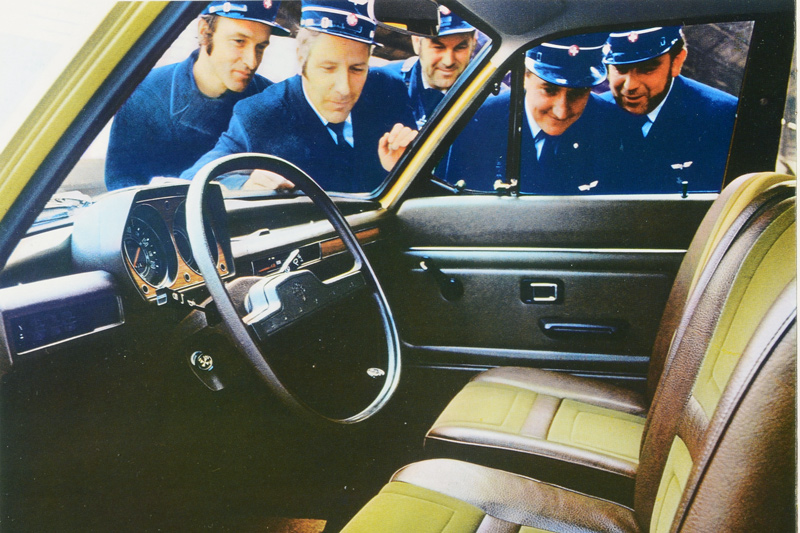
Oskar's versatile field of work is a fairly new area of automotive design. Drivers notice this when they switch from an older model to a new one. In the past, car seats were designed based on the experience of furniture architects and upholsterers. The more expensive the car, the softer the seats!
But a car seat is not a club chair, even if "comfort in the first seat" is a strong selling point. The decisive factor is not how you sit in the first minute, but how you sit in the last minute - the last minute after hours of driving. In a car seat, you remain relatively motionless while performing a task that requires maximum concentration. The driver must be free from physical strain, so it is not enough to make the seats soft. Because sinking into the soft cushion also makes the spine round and crooked, and the person has to forcefully resist this rounding. The many intervertebral disc problems of our time come from a crooked back, from incorrect strain on the spine - even in incorrectly designed car seats. The ideal seat curve is not a half 0, but a flat S, with strong support under the thighs and in the kidney area.
The seat designers at the Ford plant in Cologne have carried out an extremely interesting experiment. They recreated Oskar's ideal seat curve in wood. They only gave this wooden seat a foam rubber overlay and placed a test subject on it, who now had to endure several hundred kilometers of very mixed roads.
The man was not as unfortunate as it seems, he found the seat better and more comfortable than most of the others he had previously owned. This proved that the shape is more important than the softness, the correct support that enables a relaxed posture is more important than comfort in the first few minutes of sitting. At the end of the ride, the test rider had a few bruises in unspeakable places on his body, but he was neither tired nor stiff. The bruises were in places where the body does not need support, where it does not want to rest firmly but wants to float. This was also an important finding when it came to adjusting the shape and upholstery, the springs and the foam rubber pads.
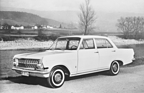
There is a lot of talk today about safety precautions for car occupants, and Ford has already shown ways to increase accident protection in the Taunus 17 M de Luxe - with padded dashboards and sun visors, safety steering wheels and smooth interior surfaces.
However, the general well-being of the driver, their freedom from fatigue and their ability to concentrate unhindered by physical strain remain a key safety factor. Riding comfortably in the correct posture is therefore not a luxury, but just as much a necessity for road safety as good steering and braking ability, road holding and powerful acceleration. Comfort has become a development task that is no less important than the task of engine and chassis designers."