Only classic cars in the fast lane?

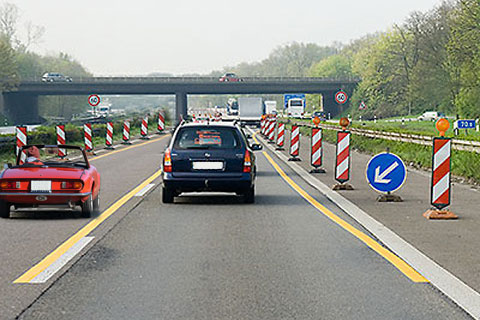
We have reported on this before, but now a new facet of the issue of "vehicle width" and traffic regulations has come to our attention. As we all know, the overtaking lanes on highway construction sites are now often equipped with prohibition signs to prevent vehicles from driving over a certain width. Most of these signs restrict the permitted vehicle width to 2.0 or 2.2 meters (the latter is only common in Germany, but not in Switzerland).
However, very few people know how wide their vehicle is. In addition, the measurement standards vary from country to country. In Germany, the folded-out rear-view mirrors are also measured, whereas in Switzerland the vehicle width without mirrors is relevant.
And now a few interesting examples: A VW Golf VII measures 1799 mm without mirrors and 2027 mm with mirrors. A current Mercedes-Benz C-Class is 1810 mm wide without mirrors and 2020 mm wide with mirrors. An Audi Q7 (2015) measures 1968 mm without mirrors and 2212 mm with mirrors. A BMW i8 measures 1942 mm in width without mirrors, but 2218 mm with the exterior mirrors folded out.
In Switzerland, therefore, most cars are currently still allowed in the overtaking lane, which is regulated to two meters; in Germany, only small cars are allowed in the two-meter lane, while most passenger cars are allowed in the 2.2-meter lane. Mercedes-Benz Sprinter vans are practically taboo everywhere, because even the last model with mirrors could be well over 2.2 meters wide. And cars seem to be getting wider every year. Passenger cars will soon be over two meters wide, even without mirrors, if things go on like this.
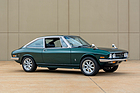
The classic car is, of course, in the clear. Apart from the fact that most models built up to 1990 were less than 1.7 meters wide, they often only had one exterior mirror and in any case they were much narrower than the two "ears" prescribed today.
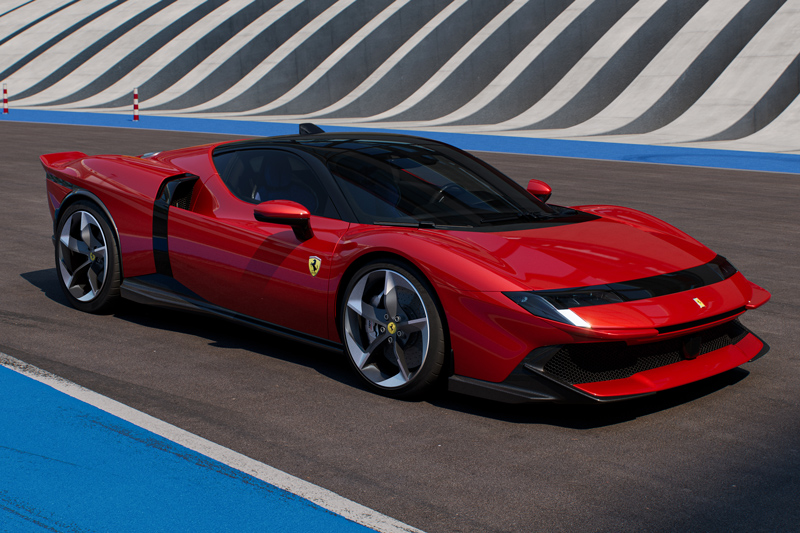
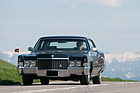
Of course, there were exceptions. A Ferrari Testarossa was already 1976 mm wide in 1984 and that without mirrors. And a Cadillac Series 62 already exceeded two meters in 1959! A Triumph Spitfire, however, was only 1448 mm wide (without mirrors), which of course fits perfectly in any fast lane.
So if the growth in width continues as it has over the last ten years, the classic cars will soon be alone in the left-hand lane in the roadworks area. However, this will not lead to good utilization of the traffic area.