The microwave is unstoppable and what it has to do with classic cars

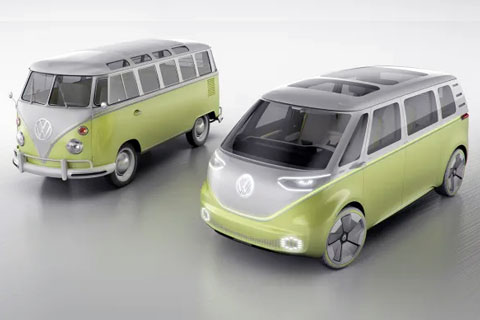
Discussions are in full swing as to whether the electric car will prevail and whether it will even have a significant share of the total vehicle volume. Doubters and optimists seem to balance each other out, and there are arguments for almost all predictions.
However, it is becoming increasingly clear that the electric car will make its way, too much energy, i.e. investment, is currently flowing into this drive technology and the political pull is also too strong.
In 2018, only around 2.1% of new cars were electric, but in terms of unit numbers, this is already a considerable amount. However, the rapid growth is currently not primarily taking place in Europe, but in China, for example, where over one million electric vehicles were sold in 2018.
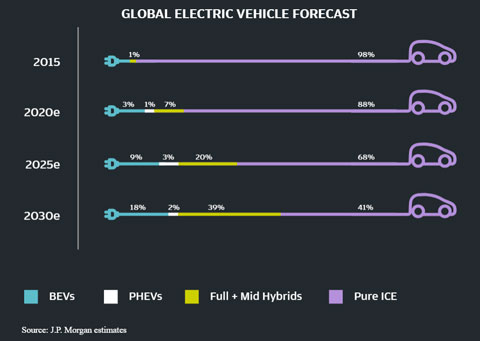
It is therefore not surprising that analysts and industry experts are expecting a strong increase in electrically powered cars. J. P. Morgan, for example, already sees fewer cars on our roads equipped purely with petrol or diesel engines ("pure ICE") than electric vehicles ("BEVs") or hybrid cars ("PHEVs"), which also include mild hybrids, by 2030.
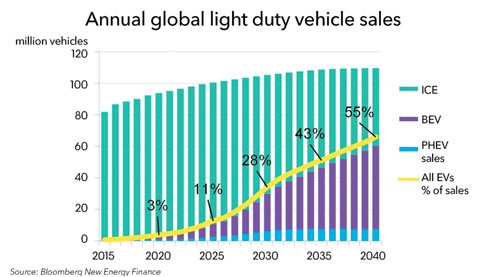
Bloomberg looks a decade further and expects 55 percent of all cars sold in 2040 to be electrically powered (including hybrid vehicles).
However, most well-known studies also assume that even in 2040 or 2050 there will still be many cars with combustion engines on the road, so they will not disappear that quickly, even if, as Morgan Stanley predicts, 69 percent of all cars sold in 2050 are electric.
One of the major obstacles for electric cars is their range on a single charge and the cost of the entire battery technology. However, even sceptics have to admit that huge progress has been made in the last ten years. Just a few years ago, the few existing electric cars had a range of perhaps 120 km with significantly lower mileage than "normal" passenger cars. Today, a Tesla 3 or even a Nissan Leaf can manage at least 300 km, with mileages at least comparable to diesel/petrol-powered cars.
And it seems that further major improvements are possible. In Switzerland, for example, the company Innolith has announced that it is building a super battery that has two significant advantages over the batteries currently in use. On the one hand, the energy density is said to be around three times higher than that of batteries currently in use and, on the other, the solid-state battery technology used is said to be less temperature-sensitive and, above all, no longer flammable. Regardless of whether Innolith has achieved the breakthrough or whether another company will hit the big time, it can be assumed that significantly greater ranges will be possible in just a few years' time. And with every advance, the pressure to replace today's combustion engines with quieter and less complex electric drive technology will also increase.
For classic car owners, this means that their car from the sixties or seventies will look even more exotic, as it emits exhaust fumes and produces a lot of noise. Whether the already noisy population will accept this and in what form is open to debate. What is certain is that the network of filling stations will shrink, that repair stores specializing in electric cars will hardly be able to deal with the old cars and that there will be little understanding on the roads for the special features of the old cars.
Another hotly debated topic today is whether the electric cars of today will be the classic cars of tomorrow. There are doubts as to whether these cars can arouse sufficient emotion. In addition, the maintenance and servicing problems are not likely to stop at these early electric cars.