The price trend for classic cars and inflation

Yesterday, we published a table with market valuations of popular and special classic cars , comparing prices from 1989 with those of 2019.
Today we would like to add a few more observations and thoughts.
According to consumer index statistics, prices in Germany have risen around 1.6 times between the end of the 1980s and today.
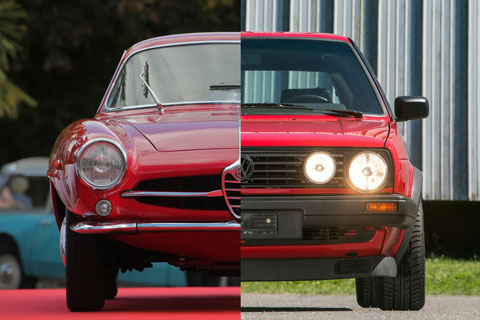
If you take a closer look at the price development of new cars, you could, for example, compare the VW Golf 1.8 CL with 90 hp from 1989, which cost DM 22,725 ex works at the time, with today's Golf TSI Comfortline, which costs around EUR 24,975. If we convert the DM 22,725 into euros, the 1989 Golf would have cost EUR 11,619. It has therefore become 2.2 times more expensive over the years.
The situation is similar for the '89 Opel Vectra 1.6i GL, which cost DM 22,700 at the time, if you compare it with a modern Insignia for around EUR 36,470. In this case, the price would be 3.3 times higher. Obviously, cars have grown in price more than the usual shopping basket of statisticians. This can also be seen in the increased comfort and more space, because you would actually have to take a Polo or Astra today to compare it with the Golf or Vectra of the late 1980s.
So let's stick with the general price increase of 1.6 times. This means that you would have lost money on all classic cars from the fifth-last position in the table if you owned them for more than 30 years. If you even set the bar at a factor of 3.0, around 1/3 of cars would be cheaper today than they were back then.
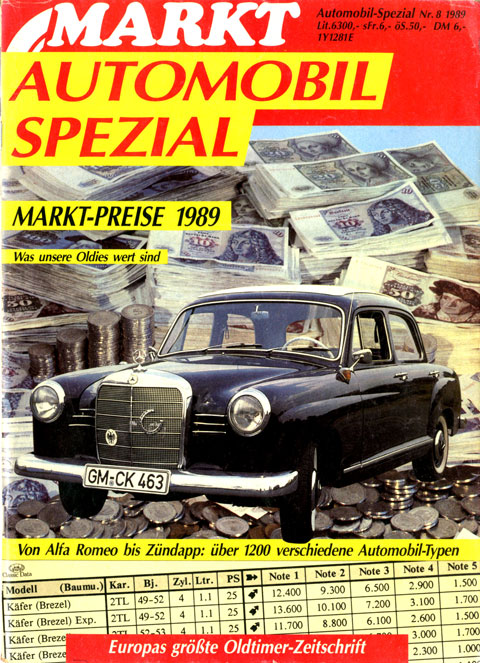
But it gets even worse. In 1989, the authors of the "Marktpreise" booklet wrote that their valuations were based on private sales, whereas dealer prices could well be up to 30 percent higher than those quoted. And with good reason (warranty, additional services, etc.). This would reduce the "value gains" even further.
But these considerations are of an academic nature anyway, because we can't go back to 1989 and buy the "right" classic car.
However, there is something else that strikes you when you look at the 1989 market price booklet. The selection of vehicles was completely different from that in similar publications today: The Japanese were almost completely absent, The youngest cars with listings were just ten years old, some even younger! There were hardly any US vehicles, nor were there any exotic cars with small numbers. Yes, it was certainly a different classic car world 30 years ago.
And another final comment is also in order. While the 1989 price booklet cost DM 6.00 (the equivalent of EUR 3.07), the 2018 edition costs EUR 7.90. So there it is again, the factor of 2.6, but it's like comparing new cars: the current issue is much thicker, much more colorful and much more complete. You are happy to pay EUR 7.90 for that.
And this is what the magazine looked like in 1989: