Cousin Egbert's Christmas tree
Every now and then - depending on my mood - I delve into the trusty family photo album and flick through the numerous, somewhat worn pages to review in my mind some of the escapades photographed in it. Some that have remained engraved in my memory since my earliest childhood, especially some that dealt with one of the adventurous episodes that my great-uncle Xaver used to tell me up close during his visits as he examined one or other of the photos in the four triangular brackets.
I have to admit that not all of his memories were always uplifting, but one of his virtues was honesty - most of the time. For example, he told me the literally moving story behind a photo that I was particularly taken with. In short, his story was extremely adventurous. As we know, there were more than enough adventures in his repertoire, as Uncle Xaver was one of the pioneers of early automobile and airplane development. At the beginning of the 20th century, he designed and constructed the famous Autokutsche and Aerokutsche motor cars and flying machines in a suburb of the well-known town of St. Gallen, close to the shores of Lake Constance.
And the story mentioned above, which Uncle Xaver dredged up from his memory, was connected with a beautiful Christmas tree, a photograph of which I was just looking at. The large fir tree was lit with twinkling candles and beneath it lay countless festively wrapped presents, while socks stuffed with all sorts of goodies hung on the edge of the fireplace in old English style. Of all the heart-warming, peaceful and friendly images, this Christmas tree should have topped the list. Even today, it is difficult for me to comprehend the outrageous sequence of events that led to this symbol of peace and quiet between the leather-bound album covers. This image seemed like a contrast to the rather wildly racing cars in the photos that adorned the rest of the two open album pages.
Suffice it to say that on a beautiful, mild October day in the fall of 1903, the then ten-year-old cousin Egbert wished for a large, magnificent Christmas tree to celebrate the triumphant motor coach victory in the extremely tough city-to-city races - the "Four Nations Prize for Speed and Endurance" from Vienna to Paris - at the end of the previous September. The laurel wreath for the famous Swiss car brand went to the fearless number one driver Emerich Arthur Richard Eugen Herzog von Kretzenburg, together with the ever-busy chief mechanic Albert, who often leaned far out of his seat to the Duke's left in fast, sharp bends.
And so, as my great-uncle had further explained to me in the long-gone days of my youth, the future heir to the motor-carriage was supported by none other than chief engineer Dudley Pringle, whose thoughts were mainly occupied with testing new prototypes. The procurement of a first-class evergreen fir tree was tackled in order to store it in the Autokutsche factory's spare parts depot in time for the coming holidays. Dudley Pringle's wishes regarding the testing of a new Autokutsche prototype were also taken into account.
After a brief discussion around the large round table that Mr. Keller, the Rössli landlord, always reserved for the team from the nearby Autokutsche works, Uncle Xaver's artistically and technically gifted younger brother Michel-Angelo took another, no less large bite of Mr. Keller's excellent "Schüblig" before interrupting the silence that had settled around the table. But before he could present his newly formulated thoughts, he was interrupted by the Rössli landlord. It must be mentioned at this point in the story that Mr. Keller's Schüblig was very popular far and wide, and he was always experimenting with new ingredients to refine the basic recipe. "How do you like my new, truffled Schüblig?" he asked.
"Ummm," came the reply, while Michel-Angelo quickly speared a second large sausage with his fork, his broad beret quivering as a result of a well-calculated, sudden movement.
"Well, I suppose that's a kind of answer too," Mr. Keller muttered to himself, a little annoyed. "I must now go off with Cordelia (his truffle-sniffing piggy) to find more truffles. I suppose you'll be setting off now with the new prototype to find a nice Christmas tree for yourselves."
No sooner said than done, everyone rose from the round table. And the nearby forest was certainly the most suitable testing ground to try out Uncle Xaver's latest achievement: the "Push-Pull". The name of Uncle's prototype was of course borrowed from the English-speaking world, as he and Uncle Michel-Angelo had been looked after by a British nanny when they were young. And the language, which had taken root wherever the sun never set, had already become the new lingua franca.
It was of course the ever-creative Michel-Angelo who had given the prototype its name, which perfectly matched the revolutionary off-road characteristics of the Push-Pull. They originated from one of his sometimes crazy, but often ingenious basic ideas.
The actual technical details were then worked out by Uncle Xaver and Duduley Pringle. The mechanical wonder was an early attempt to replace the farm horse and also to facilitate other labor-intensive and tedious routine functions of early 20th century farmers.
At each corner of the chassis of a 40 hp long-wheelbase autocarriage touring vehicle was a powerfully dimensioned, long, forged steel pivot-mounted arm, pointed and rounded at the front, which could be raised and lowered in the vertical plane. These front and rear swing arms at the ends of the chassis were parallel to each other. An approximately 1.5 m wide, drum-like roller with a relatively large diameter was mounted between the front ends of each pair of swinging arms on the generously dimensioned, 1.77 m wide chassis and ran in ball bearing cages - the latter a technically pioneering autocarriage achievement of the time.
5 cm wide and 1.25 cm thick strips of India rubber were riveted close together on the surface of each roller and provided maximum traction on rough terrain when the front and rear rollers were lowered to ground level. Each of the two rollers had a circumferential, central groove that was double-toothed, with the interlocking teeth of a duplex chain ensuring the rotation of the respective roller. The chain was driven by a large double gear wheel, which ran centrally on a forged steel shaft a few centimetres in front of the pivot bearing housings of the respective pairs of swing arms, also in pivot bearings, and provided a further rotating cross-connection between the parallel arms.
As the length of the duplex chain always remained constant, this ingenious system enabled a constant, secondary drive of the two rollers regardless of their position. Two smaller sprockets, which formed part of the primary drive, were welded to each side of the large rear sprocket of the secondary drive on the shaft and caused it to rotate. These smaller gears were in turn driven by two further differentials mounted on each side of the chassis behind the front seats. A special heavy-duty clutch in front of the differential engaged or disengaged the primary chain drive. And two short shafts on either side of the differential were connected to sprockets mounted on the side of the chassis, as in the era, which drove the rear wheels; also with duplex chains, an Auoto coach safety measure that ensured drive despite a chain break on one side.
This design was completely different in effect to the one that later became the classic tracked drive, but the rollers also provided good off-road mobility, similar to side-mounted tracks, but pulling and pushing from the front and rear. It is important to realize that in 1903 there were no all-encompassing, international communication systems that offered inventive engineers the opportunity to review existing, primitive caterpillar drive projects dating back to the early and mid-19th century. And Uncle Michel-Angelo, imaginative as he was, didn't give a damn about the caterpillar drive. After all, he was a little eccentric; actually a bit more than just "a little." But his system worked! And whether it did, as we will soon see.
A large lever placed on the driver's right-hand side in front of the gearshift and handbrake lever for the rear wheels acted on hydraulic cylinders that lowered or raised both pairs of swivel castors depending on whether they were advanced or retracted. And to ensure an acceptable vehicle length when driving on the road or when "garaging" the machine, the rollers could be raised and swiveled further above the horizontal plane so that they rested on correspondingly strong supports above the body of the 40 hp long-wheelbase Autokutsche Tourer and were locked in place, with the front roller pointing backwards 30 degrees from the horizontal plane and the rear roller pointing forward 30 degrees, with a large teaching space in between, over the two rows of seats until they were unlocked again.
This was chief engineer Dudley Pringle's ingenious idea, which Michel-Angelo could not begrudge him. Another of Dudley Pringle's contributions was the vacuum fuel supply via a rather primitive but effective injection system, a real novelty at the time. This meant that off-road mobility would not be impaired by steep sections of road. Uncle Xaver had thus built the forerunner of the tractor, with the advantage of a higher, roadworthy speed compared to future versions equipped with caterpillars. This advantage resulted from the already mentioned, relatively widely spaced traction rollers, which could be stowed compactly above the body!
And so, late in the morning on a peaceful October day in 1903, it was off to the nearby forest on the shores of Lake Constance with the aim of finding a relatively large fir tree, sawing it down and hauling it back to the factory to fulfill Cousin Egbert's fondest wish for a large, magnificent Christmas tree. Chief Engineer Dudley Pringle had stowed three axes under the rear seat of the push-pull. Cousin Egbert took his place next to Uncle Michel-Angelo, while Uncle Xaver sat behind the large, wooden steering wheel, with Dudley Pringle to his left.
When they reached the edge of the forest on the shore of Lake Constance, Uncle Xaver stopped briefly and pushed the large lever in front of the gear and brake levers on his right forward to lower the two rollers, activated them and disengaged the clutch. When he then pushed the ignition forward and accelerated hard, the mighty push-pull roared thunderously into the forest, rolling down smaller bushes under the pounding weight of the front roller. Uncle Michel-Angelo had brought a pair of powerful Zeiss binoculars with him and suddenly shouted "Eureka!" Lo and behold, about 50 meters to the right of the thundering and rumbling push-pull, he had spotted a fir tree of the size he was looking for.
When they had almost reached the future Christmas tree they were aiming for, they were surprised by a sudden, deafening and horrible squeal coming from the thicket. A completely terrified Cordelia approached the push-pull, while her Mr. Keller, clutching his partially filled basket of precious truffles tightly, ran after it as fast as he could. The little pig, obviously totally frightened by the roaring, thrashing apparition, had dashed away in a panic and recognized the push-pull with four faces she knew well - pigs are known to belong to the more intelligent species of animals - as the safest place. With a mighty leap, she jumped onto the right front seat, knocking over Uncle Xaver and subsequently Dudley Pringle as well.
The suddenly uncontrollable push-pull now rolled forward noticeably slower, as Uncle Xaver's foot had slipped off the centrally placed accelerator pedal, and approached the targeted fir tree at reduced speed. Uncle Xavier tried desperately to straighten up, but the loudly squealing Cordelia, who was wedged between him and the levers, prevented him from doing so. With an almost superhuman strength of desperation, the great-uncle, reaching over the piggy, tried to grab the brake lever, but instead caught the lever in front of it, which operated the hydraulic cylinders. The two rollers slowly but surely began to lift.
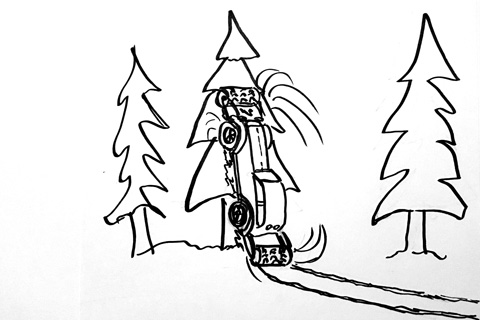
Just at that moment, the push-pull touched the trunk of the fir tree and while the front roller continued to lift hydraulically, this somewhat differently designed predecessor of the tractor began to climb the tree trunk at an ever-increasing angle. Michel-Angelo clutched his Zeiss binoculars tightly and jumped off the rear seat, landing rudely on his backside. The nimble Egbert, landing skillfully on his feet, followed him. Mr. Keller, having arrived by now, helped Michel-Angelo back onto his feet, while the push-pull, with its slowly rotating front roller still striving for its 30-degree angle position, climbed up the trunk consuming the tree bark, while the rear roller, also slowly lifting, continued to push him with its rotation. With the big engine idling and the ignition in the forward position, one misfire after another rang out. The now totally excited little pig squealed at the top of its lungs as it was thrown off the machine together with Uncle Xaver and Dudley Pringle.
The wildly squealing Cordelia dashed away like a flash of pink and red as fast as her short legs could carry her, and the two stalwart motorists who had been sitting in the front seats also scurried to safety.
Finally, after a somersault on its back, the push-pull landed on the now hydraulically retracted rollers, which, still rotating, sought their resting position above, but now below, the car as they dug steadfastly into the soft ground. Thanks to Dudley Pringle's vacuum fuel injection system, the engine kept running. Then, as the two rollers engaged, the now-reversed push-pull rumbled and rattled awkwardly back in the direction from whence it had come, still accompanied by the deafening backfiring of its powerful in-line four-cylinder engine as its rear drive wheels, jutting skyward, spun ineffectually. Soon the vehicle reached a marshy sandy beach and disappeared into Lake Constance with a clearly audible hiss.
And the result of this failed mission? A team of draught horses pulled the finally felled fir tree out of the forest and all further thoughts of building a second push-pull were shelved, as the design and manufacture of a successor to the 40 hp touring car was given priority.
However, the beautiful, large fir tree was duly placed in the large living room of the villa, which, as was customary at the time, was located within the Autokutsche factory premises, in such a way that the peeled bark of the tree was invisible against the wall. Festively decorated with countless twinkling candles, it radiated the expected peace and solemnity as Cousin Egbert's Christmas tree.
Editor's note: Do the extras in this story look familiar to you or would you like to read more about the adventures of Uncle Xaver and Engineer Pringle? Then we recommend taking a look at the book "An Pferden kein Mangel".

.jpg)