Almost half of classic car drivers have no problems with today's gasoline


There's a bit of a feeling of unease on the scene about modern gasoline qualities and their blends. It started around 30 years ago when lead was removed from the fuel. From then on, many drivers of old cars mixed lead substitute additives into their gasoline. For some years now, the alcohol content in petrol has been rising, and oil companies are increasingly mixing additives into the fuel to increase the service life of the engine and reduce consumption. But the more petrol changes, the greater the question of whether the old engines can cope with it.
Do the special requirements of classic cars, e.g. long idle times, infrequent use, etc., lead to subsequent problems with today's fuel?
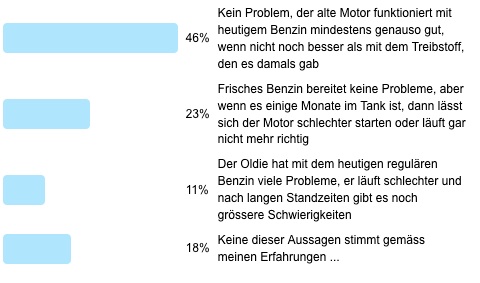
We put this question to our readers and were actually surprised that 46%, i.e. almost half of the respondents, found modern fuels to be harmless, i.e. they had no problems with them.
However, there is also another half and this is where the 23% of classic/young car drivers are to be found, who mainly have problems when the car has been left standing for a long time. A further 11% report major problems and even poorer running characteristics, while 18% probably have some kind of problem but did not see these correctly formulated in the questions.
In any case, the classic car community is not entirely satisfied with the quality of today's gasoline, and we will continue to work on this issue.
As always, here are the complete answers for the sake of completeness:
And of course we have already asked the next question, this week we want to know how much protection against fire and fire hazards makes sense for classic cars ?
All previous questions of the week and their answers can be found in the "Question of the week" topic channel .