The Porsche 917won Le Mans in 1970 and 1971 and was certainly not even remotely intended for use on public roads, even though it was considered a sports car according to the regulations of the time and even had license plates for overpasses. There were also really "normal" registered Porsche 917s, at least two of them. One cleared the German registration hurdles long after its active racing days, thanks to its laminated glass windshield and various other modifications, while the other was largely registered in racing trim in Alabama, i.e. in the United States, where it hardly ever appeared.
There was even a rumor that the authorities there would only grant the car a license plate if it never appeared there. Nevertheless, it met all the requirements for a small series vehicle there and did not have to withstand a collision with a wall, as France had demanded. In fact, it is said that no requested European country was prepared to approve the car at the time. At least not without extensive modifications.
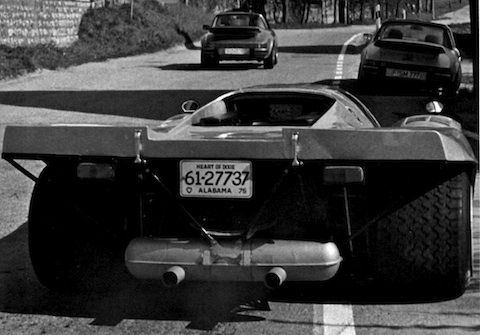
Count Rossi, the owner of the car and also responsible for the sponsorship activities of drinks manufacturer Martini & Rossi, wanted to keep the car as original as possible. After all, a blue-grey metallic paint job replaced the previous Martini décor and the car was fitted with a huge silencer at the rear, which, according to Paul Frère, who wrote an entertaining article about the car for Road & Track magazine in 1975 (issue 1/1975), must have cost around 40 to 50 hp.
![Heckansicht der Porsche 917 des Grafen Rossi mit grossem Schalldämpfer im Jahr 1975]()
But even so, there were still 500 or 600 left, which the 917 could shake out of its sleeve with its twelve-cylinder engine. Inside, there were two bucket seats and otherwise few changes to the racing car equipment. Cruising consumption is said to have been around 30 liters per 100 km.
The Porsche 917 with chassis number 917.030 belonging to Count Rossi is a particularly interesting specimen from a technical point of view because it was equipped with one of the first anti-lock braking systems (ABS from Teldix) as early as 1971, which added around two seconds per lap during test drives, but was never used in racing.