The Bugatti Royale and its colossal engine
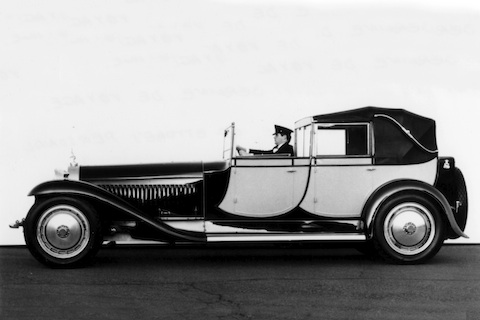
Ettore Bugatti was a French automobile designer of Italian descent in the 1920s with a strong artistic influence. His aim was to create a luxury vehicle that was superior to competing models from Rolls-Royce, Bentley, Mercedes-Benz, Maybach and Cadillac and that was to be powered by the most powerful and smoothest-running engine of its time. Ettore Bugatti's main customers were the European royal families and the wealthy of the time.
The "Bugatti Royale" was elaborately designed and reached a top speed of 200 km/h thanks to its 300 hp engine. The bodywork of the "Royale" was exclusive and caused quite a stir. Nevertheless, the car was not a commercial success for Bugatti: only six chassis were built in nine years, two of which could not be sold.
The first vehicle was produced in 1926. As was customary in the luxury car segment at the time, Bugatti only supplied the "rolling chassis", i.e. the chassis with all components including the engine and radiator grille, while the design of the body was left to independent coachbuilders. Commercial success failed to materialize due to the onset of the global economic crisis at the end of 1929. Ettore Bugatti was very selective and only sold the Type 41 to people he liked. Other reasons were the very high price and potential customers who were reluctant to purchase such an exclusive vehicle in these difficult times.
Not a single Royale made it to Argentina, one of the eight richest countries in the world at the time, although some of the "Ricachones", such as the legendary Fabián Gómez Anchorena, could compete with most monarchs.
Due to its price, its exclusivity, its technology and the small number produced, the vehicle is a legend today. All six vehicles still exist.
The radiator mascot of all "Royale" models was an upright elephant designed by Ettore's brother Rembrandt Bugatti as a satire on Rolls-Royce's winged Spirit of Ecstasy radiator mascot.
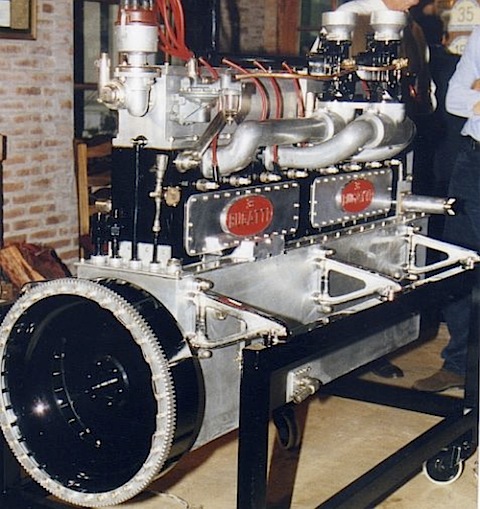
It was powered by an eight-cylinder in-line engine with 24 valves. It had a displacement of 12.7 liters and an output of around 300 hp. The engine block was one and a half meters long, was lubricated with 14 liters of oil, cooled with 48 liters of water and supplied from a petrol tank with a capacity of 190 liters. The total weight of the vehicle was around 3200 kg. In terms of dimensions and displacement, the eight-cylinder engine block was one of the largest engines ever used in a road vehicle.
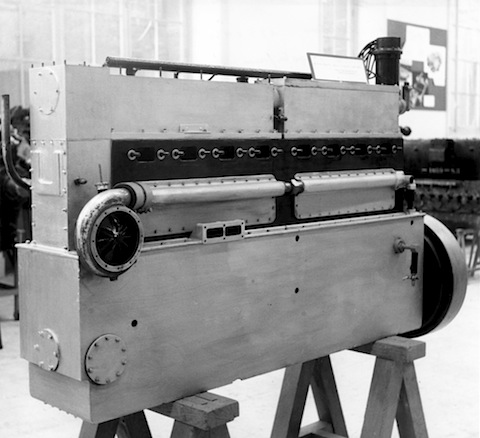
In order to keep costs under control, Bugatti also produced engines for the French state railroads SNCF, which installed them in high-speed railcars. One such engine was imported to Argentina by a collector around ten years ago.