Fittipaldi 3200 - The double boxer

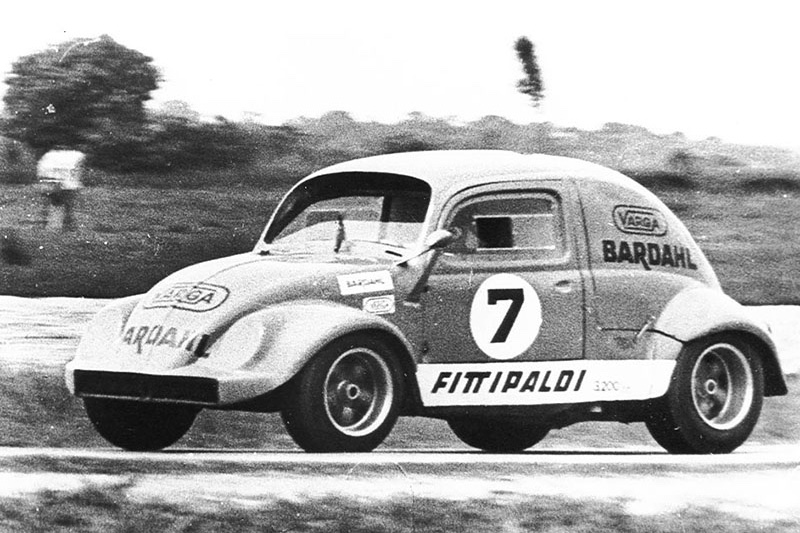
Between winning the English Formula 3 championship and his entry into Formula 1 the following year, Emerson Fittipaldi wanted to quickly shake up the sports car scene in South America in the fall of 1969. However, the sports prototype with an Alfa Romeo engine originally planned for this was not ready in time, so Fittipaldi Veículos e Equipamentos de Competição spontaneously decided to take the idea of the racing Beetle built the previous year to the extreme.
Without any real construction plans, but simply based on sketches by Ricardo Divila, the floor assembly of a VW Beetle was cut in front of the rear wheels and a tubular frame was installed in place of the rear engine mounts. Trailing arms from a Formula Vee racing car improved the wheel guidance of the standard swing axle. The brakes were provided by a discarded Porsche 550 Spyder, which also supplied the five-speed gearbox, reduced by the lowest gear.
Two VW boxer engines coupled with a simple hard disk, whose crankshafts were offset by 90 degrees, were intended to eliminate the power deficit compared to the American competition. However, the 400 hp often quoted was probably a very optimistic estimate. With contemporary tuning methods, around 130 hp could be tickled out of a 1600, so that the improvised eight-cylinder engine was probably somewhere between 250 and 300 hp - which was still impressive with a fighting weight of just over 400 kg.
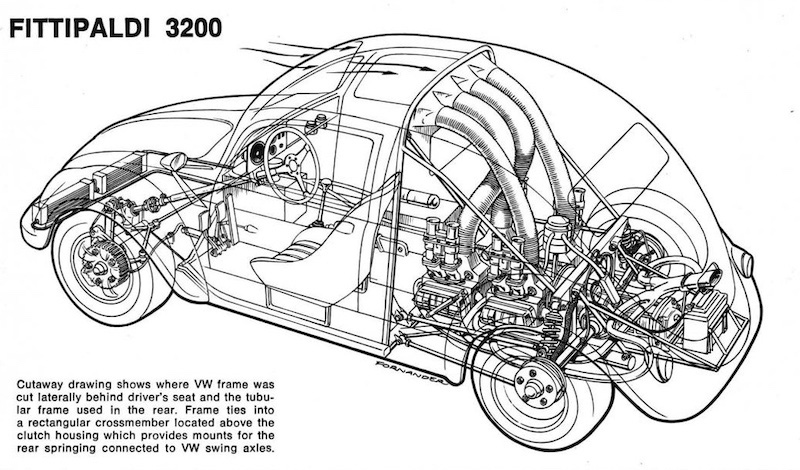
For the construction of the body, a standard Beetle was covered with a wafer-thin layer of GRP. The rear of the plastic skin, which weighed just 17 kg, could be folded up in one piece, just like the Ferrari 250 LM. The lightweight construction went so far that even the cooling fan was dispensed with. Instead, the sloping windshield formed an air intake that directed the cooling airflow through a kind of "false ceiling" through four thick hoses directly onto the cylinders.
In his first outing - the 1000 km of Guanabara in the south of Rio de Janeiro - Emerson Fittipaldi gave the competition from the Ford GT40, Lola T70 and Alfa Romeo Tipo 33 a good shake, but retired from the race with gearbox damage. Brother Wilson is said to have suffered a similar fate in the second and final outing of the double-heart Beetle. Converted back to four cylinders, a few more races followed before the Fittipaldi 3200 ended up as a decoration at a driving school.
The whereabouts of this awesome Beetle are unknown. It was probably scrapped back in the seventies. The car that now stands in the JORM Museum in Águas de Lindóia is a replica.