Obituary Ratan Tata - He wanted Land Rover and fell in love with Jaguar
10/11/2024

Ratan Tata had more British class than many an English manager, developed a car for the masses and fell in love with a brand that he didn't actually want at first.
"When Ford put Land Rover up for sale, we were very interested in it as the largest truck manufacturer in Asia - the 4x4 sector fits in perfectly," Tata once remarked during a motor show in Geneva on the reasons for the takeover. "Jaguar was not even on our radar at the time. However, the technical integration of the two brands Jaguar and Land-Rover meant that it was no longer possible to separate them, or it would have been far too costly," he explained why he took over the sports saloon and sports car manufacturer in Coventry in addition to the off-road vehicle and SUV manufacturer in Solihull.
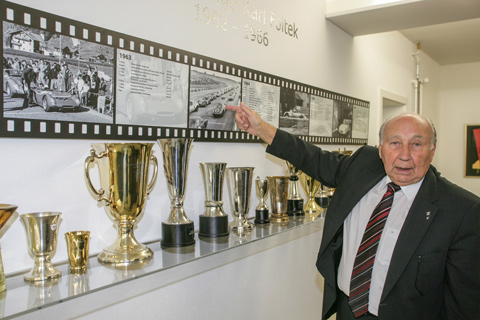
"Tata was not at all aware of the history and significance of the Jaguar brand when it came to him in a package with Land Rover. He once told me this at a dinner during his first appearance with Jaguar in Pebble Beach," revealed Jaguar collector Christian Jenny, who was friends with Tata and even had the pleasure of hosting him at his home. Our photo was also taken on this occasion.
From 1991 to 2012, Tata was Chairman of the huge conglomerate, whose origins as a trading company date back to the mid-19th century. In 2017, he took on this role again for a brief four months following a dispute with the Group's CEO at the time. Cars have always played a certain role at Tata. The Nano - a project for the four-wheeled motorization of broad sections of the Indian population - is still vividly remembered. In response to criticism, mostly from the West, that the car hardly met the minimum standards of local safety requirements, Tata expressed himself in a plausible manner: "If people sit in my car instead of two, three or more on a motorcycle, then this is already a significant gain in safety!" With its price, the Nano was aimed precisely at the most popular motorcycle in India at the time: the Enfield Bullet. The Nano failed to live up to its expectations. The Indian public - as elsewhere in the world in markets where mass motorization is still to come - expected a "real" car - one that had something to offer.
With the Nano, however, Tata has managed to evolve from a national manufacturer to a global brand and make its mark on the international consciousness. And Ratan Tata really fell in love with Jaguar: "I fell in love with the brand," confessed the man who had studied at Harvard and was considered one of the biggest supporters of educational projects in India. After buying Jaguar, Tata got himself some books and read up on the history of the manufacturer. He was convinced that Jaguar had to be preserved in all its facets and against the backdrop of its impressive history. Those responsible today see things somewhat differently: "The history of the Group is much older than that of Jaguar, and the automotive sector is only one part of the overall business", as Jaguar PR boss Ken MacConomy revealed last year on the occasion of the Jaguar F-Type's farewell drive.
Ratan Tata - one of the few great personalities left in the automotive industry and one of the last visionaries in the business - died on October 9 at the age of 86.