How far would you like it to be?

1.16 liters per 100 kilometers - that's the fuel consumption I recently achieved at an average speed of 50 km/h. I was driving an electric car. With an electric car. The reason for this was an invitation from Volkswagen Switzerland to take part in a range test over two days. Seven journalists from the most important Swiss print media were invited.
Our test object: the latest Volkswagen in the ID family, the ID.7 Pro S (86 kWh battery capacity, 286 hp output, 2.2 tons weight), effectively the electric flagship of the VW fleet. Well, electric car or not, as a passionate classic car driver and mechanic, but also as a motoring journalist, I like the idea of my everyday car taking me where I want to go, or where I simply have to go for various reasons. This journey should be as unagitated and smooth as possible, purpose-oriented. This is probably the same as a moderately inspiring muesli for breakfast, the Swiss breakfast - nutritious and healthy - instead of an opulent breakfast with bacon, eggs and the like. Because that's what Sunday is for.
So there I am on a Wednesday in September, sitting in front of the AMAG headquarters, being introduced to the art of "hypermiling" by Felix Egolf, the professional among the "economy drivers". He used to do this with combustion engines. For some time now - the word "naturally" here simply refers to the fact that the industry has shifted its focus to this form of drive - it has been electric vehicles, of course. Egolf drove one of the first Volkswagen ID.3s on the road from the Wolfsburg plant to Switzerland. Without recharging, of course.
Recharging is also not an issue on our trip on Wednesday. The goal is 700 kilometers and then some. This is the range that VW specifies as the WLTP guideline for the ID.7 Pro S. And as we know, this is usually a purely theoretical laboratory value. "It is indeed true that rain reduces the range. One reason for this is the tires on wet roads, their higher rolling resistance, the slip, but also - quite surprisingly - the reduced aerodynamics due to the raindrops on the body," says Egolf over a leisurely coffee in the foyer of the new AMAG headquarters in Cham (ZG). So it seems that the electric car really is all about saving money.
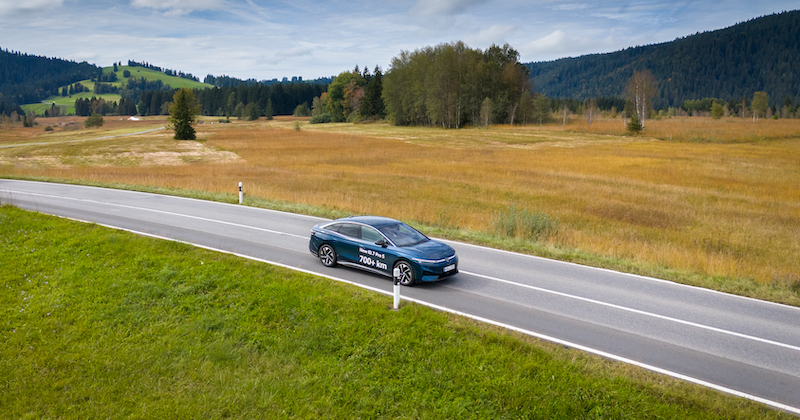
Well then, off I go. The first destination away from Cham is Arth, on the A4 highway. My right foot seems to be stuck in a kind of cramp-like rigidity. The next time I do something like this, I'll drive barefoot, so that only my big toe can gently caress the accelerator pedal. The difference in consumption between gliding (0.2 kWh/100km) and trying not to fall below the guideline value of just over 80 km/h on a slight incline (35 kWh/100km) is striking - an eye-opener. What I seemed a little unsure about at the beginning was the decision between coasting - selector lever on "N" - or recuperation? Then the display is set to "D" or even "B" for strong recuperation. However, this means that the car brakes too much on the highway.
A little confused and not quite sure whether this was good or bad consumption, I leave the A4 in Arth and drive from Goldau up to Sattel. The electric car shows that a low center of gravity can actually conceal the car's enormous weight - it sits like a board and doesn't steer too badly. The first encounter with the "Siebner" was less pleasant in this respect.
The apex of my route (which measures just under 80 kilometers) is at the level crossing before Biberbrugg. After that, it's almost all downhill to Schindellegi. A lorry driver, however, doesn't find it much fun rolling after me at 80 kilometers. But he doesn't know that I'm about to take back some of the money I've spent on the ascent. In any case, he won't get his diesel back. Shortly after Schindellegi, the route leads to Hütten. The road is narrow and the speed is very slow. An electric car like this takes correspondingly little energy from the battery. Downhill, there's a little extra here too.
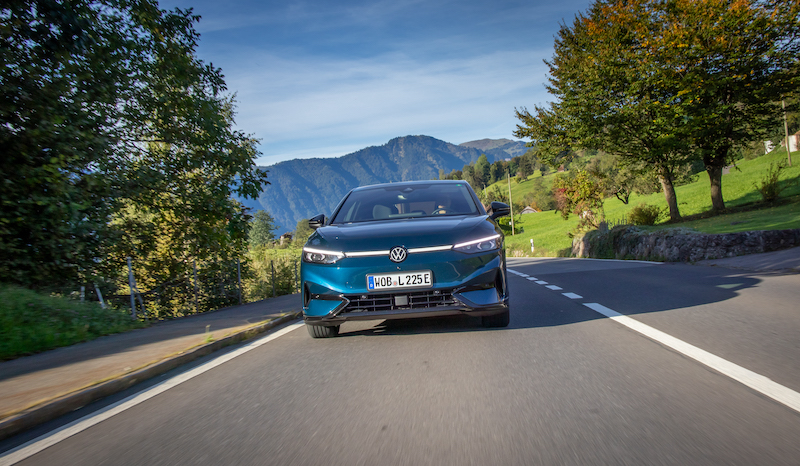
This reminds me of my standard route when I've just tuned up an "old one" or repaired something on it. It goes right through here. Have I ever thought about trying to drive with a minimum of fuel? No! At least not here. But I have elsewhere! I vividly remember a trip back from England in my Caterham Super Seven.
Back then, there were hardly any fuel pumps in France - and when there were, these ignorant, arrogant, narrow-minded machines only accepted local cards. At least at those pumps that could often be found in a corner of the huge Center Commerciales. And the other petrol stations were closed, because it was night... ah, those Gauls. Yes, we also "sailed" back then: gear out and idling, or even rolling down the hill with the engine off - no problem without any servos. Simply to save "must". Well pedaled, the Seven with its sixteen hundred cc Kent engine with double weaving also consumes around ten liters per hundred. With a reservoir of just under 30 liters, that's never enough to cover the distance from Calais to the border somewhere in the Swiss Jura. Range anxiety!
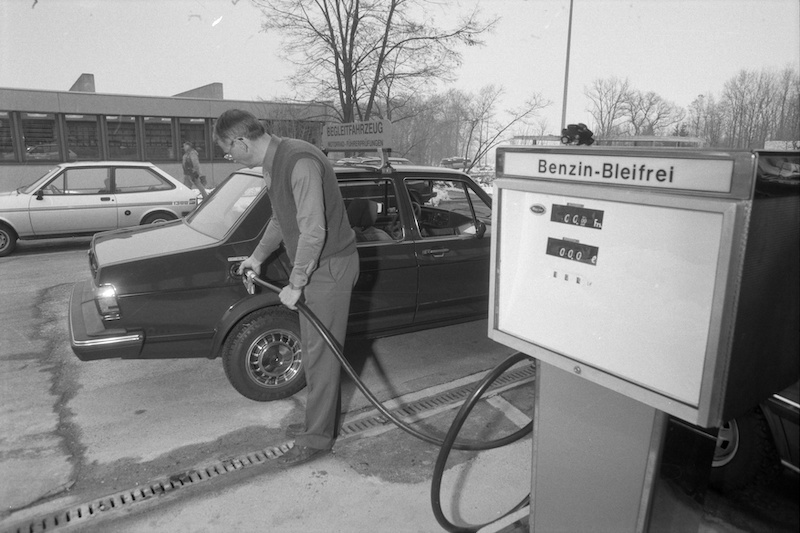
We already had that in the 1980s, when Switzerland, as the lone island of goodness, had single-handedly made catalytic converters compulsory in the middle of Europe. From 1987, we drove a Citroën BX 16 TRS - with 75 horses instead of 92 hp "thanks" to a regulated carburetor and catalytic converter - and tried to get from east to west through the French hexagon to the Atlantic at La Rochelle without causing any damage. The journey was meticulously planned in the hope that the few Postes d'Essence, which according to the TCS card had green unleaded must on offer, actually carried it. Of course, there was a bidon in the trunk - illegally, because in those days you were only allowed to bring gasoline into France in the tank of your car.
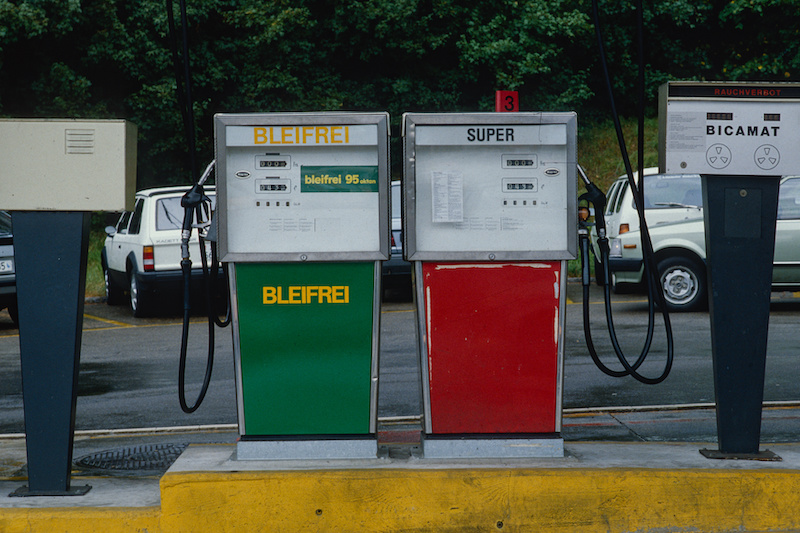
It was precisely things like this that I pondered as I was pleased that the ID.7 was pouring me down the Hirzel. As the last journalist of the seven, the ID.7's charge indicator was in the deep red after just over 700 kilometers of driving - the VW promise regarding the WLTP range had been kept. About 70 kilometers were still available to me, said the on-screen speedometer-multimedia screen-...thing. An additional loop to Mettmenstetten (a beautiful village in the Knonauer-Amt) was still waiting for me. Here too, with long, gently sloping country roads, I felt like I was rolling along for free, like riding a soapbox.
For the last stretch back to Cham, there were only very slight inputs to the "gas pedal" - "accelerator pedal" just feels wrong for an electric car. A cool Sinalco was waiting at AMAG, Felix Egolf noted the values achieved: 9.9 kWh consumption per 100 kilometers. This corresponds to a gasoline equivalent of 1.16 liters. This is a figure that rarely looks much better in the interurban-urban mix, even when driving freely. It added another 74 kilometers to the 720 kilometers that the car showed when I handed over the keys: 794 kilometers at the end of the test with two kilometers remaining in the battery. Then I took the ID.7 to the charging station.
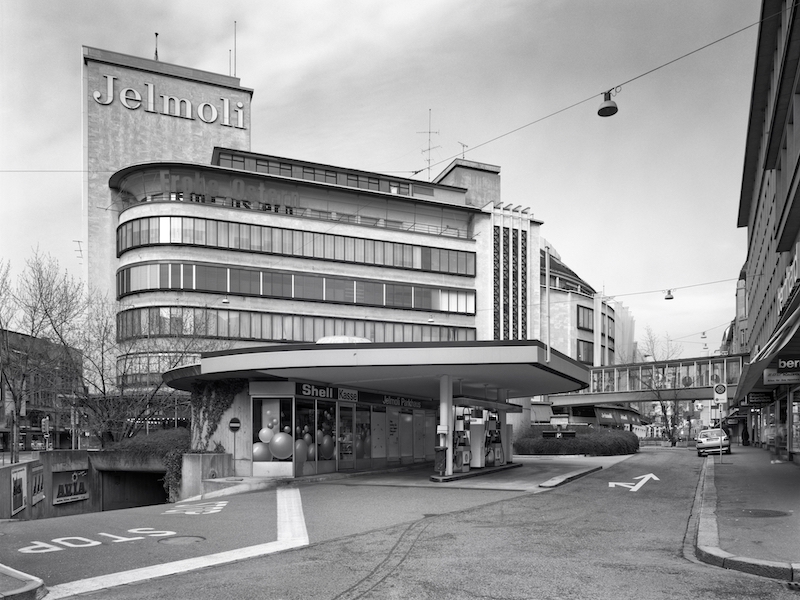
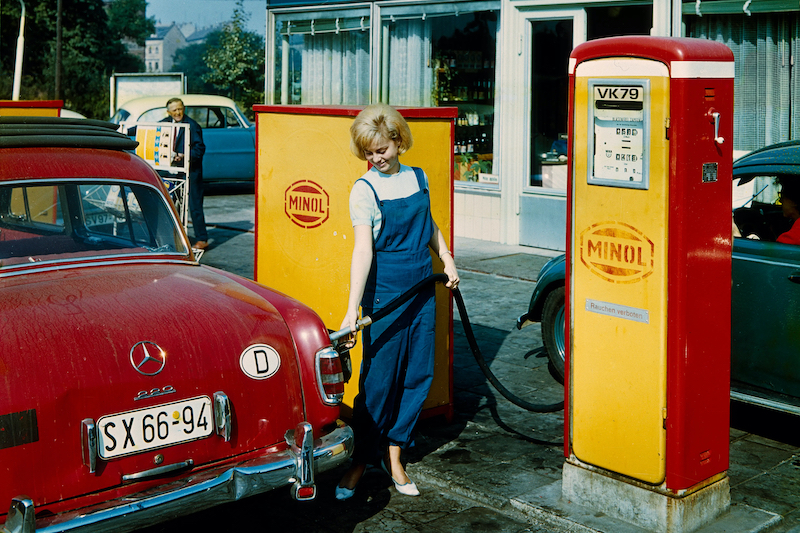
But my conclusion from this day is: it was hardly better in the past, but much nicer. If I compare a modern charging station or one of these Tesla charging locations with the wonderful temples of mobility that still shone out at motorists in the 1950s and 1960s, the filling stations, some of which were of very high architectural quality, with all their services, including hotel beds, then it hardly mattered that hardly any mid-range car back then had a range of much more than 400-450 kilometers.
Even small cars consumed more than ten liters per 100 kilometers. Anyone driving a 1600 VW 1302 could only dream of such a figure - with a tank capacity of barely more than 40 liters. Or my T1 van, also with 40 liters, could hardly drive more than 300 kilometers with its 1.5-liter engine without stopping to refuel. But refueling was still an experience back then. Charging, on the other hand, is something the industry still has to come up with before it becomes an event. If you can, it's probably best to do this overnight - virtually in your sleep - at home. Or their e-car can travel 794 kilometers.