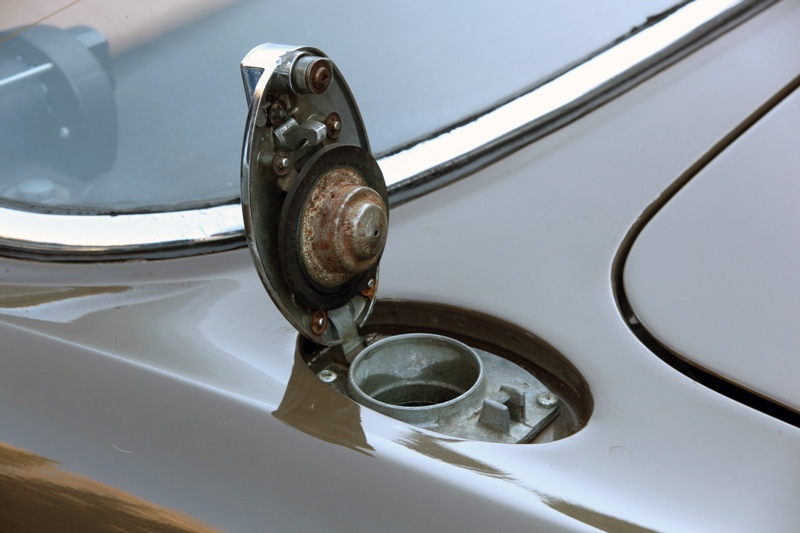
Some things used to be better (ff)

The first automobiles had the fuel tank mounted open somewhere on the chassis, later it disappeared under the body panel and instead of the fuel filler cap, aerodynamically and stylistically sophisticated designers invented the fuel filler flap, under which the fuel filler cap and thus access to the fuel tank could be found.
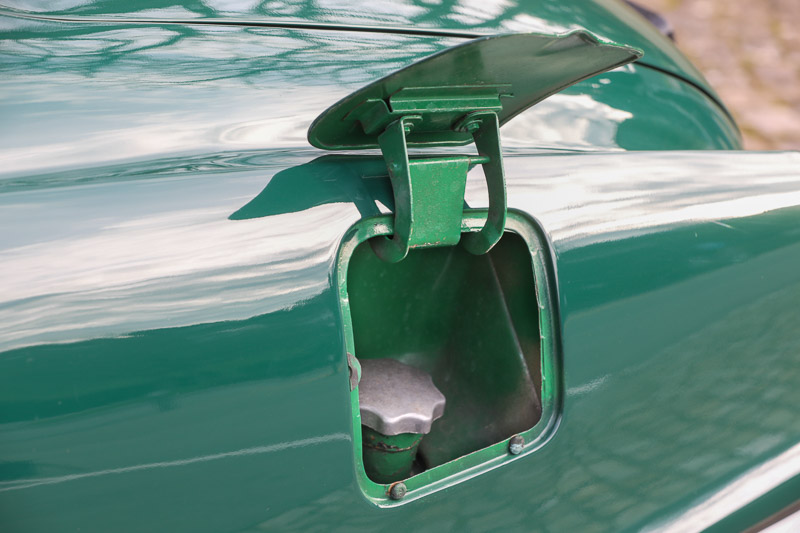
The picture shows the open fuel filler flap of the Jaguar 3.8 S. Incidentally, it has two of them, one on each side. But what struck us in particular was that the fuel filler flap opened upwards and not forwards, as is usually the case today.
An upward-opening fuel filler flap has advantages, as it protects the tank access from rain or snow even when it is open. This may not have been particularly important in cars with internal combustion engines, as refueling took a few minutes at most, after which the fuel filler cap could be screwed back on and the flap closed.
Nowadays, however, electric cars also have "fuel filler flaps" under which the power sockets are concealed. One example is the Fiat 500e. The flap opens forwards. In contrast to filling up with gasoline, however, charging can take a whole day if only a household socket is available. During this time, the fuel filler flap is open and it rains or snows happily on the plugged-in power cable. If the temperature then drops below zero, it can become a real task to pull out the plug and close the flap. If the flap were to open upwards, it would protect the power connection.
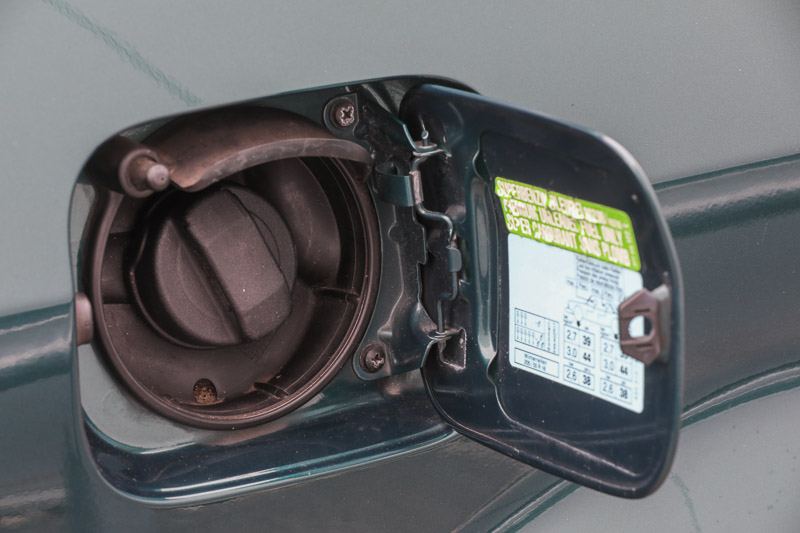
We can only speculate as to why most fuel filler flaps (in the picture the flap of an Audi) open forwards, presumably safety considerations are one reason. If you were driving with the flap open and hit a pedestrian with it, it would simply close ...
We will, of course, devote a detailed driving report to the Jaguar 3.8 S from 1968, to which the flap shown above belongs. You can buy/auction it on March 23, 2024 at the Oldtimer Galerie in Toffen.



---Tanken-im-Kofferraum-c-DR.jpg)